
Outdoor cinema has become one of the most requested upgrades in Austin backyards, and the first real decision anyone faces is whether a projector or a large-format outdoor TV actually fits their space better. Both can deliver a genuinely great movie night under the stars, though they solve the problem in completely different ways, and picking the wrong one for a given yard leads to a washed out picture or a screen that never gets used after the first few weekends.
A projector promises theater scale on a budget that a huge TV panel simply cannot match, while a large-format outdoor display promises daytime visibility and durability a projected image can never achieve outdoors. Neither option is universally better for every outdoor cinema setup, and the right call depends heavily on how much ambient light a yard actually deals with, how the space gets used, and how much patience a family has for setup before every viewing.
At Homeva, we walk this decision with clients constantly, since an outdoor cinema setup chosen without understanding a yard’s actual light conditions and layout almost always disappoints within the first season. A covered patio shaded by mature trees behaves nothing like an open pool deck catching afternoon sun, even though both spaces might seem equally suited to a big screen on paper.
Projection vs Large-Format TV: The Real Tradeoff
Projectors win decisively on scale for the money in any outdoor cinema setup weighing cost against image size. A hundred inch or larger image from a quality projector costs a fraction of what an equivalent panel size would run, making it the obvious pick for anyone chasing genuine theater scale in a backyard without a theater sized budget to match.
Large-format outdoor TVs win on convenience and daytime usability. A weatherproof panel turns on instantly, holds a bright, clear picture regardless of what time of day it is, and asks nothing of the household beyond flipping it on, which matters enormously for families who want to watch a game at three in the afternoon rather than only after dark.
Neither format is the objectively correct choice across every yard. A dedicated evening movie space shaded by structure or trees leans naturally toward projection, while a poolside area used constantly throughout a bright Texas day leans hard toward a large-format panel built specifically for full sun visibility.
Brightness and Sun: Why Ambient Light Decides the Winner
Ambient light is the single biggest factor separating a great outdoor cinema setup from a frustrating one. A projected image, no matter how many lumens the unit claims, washes out badly under direct sun or even strong indirect daylight, which is why projection works best in yards with real shade or is reserved specifically for after dark viewing.
Large-format outdoor displays solve this problem at the hardware level rather than asking a homeowner to manage lighting conditions around the screen. Panels built for full sun use significantly brighter backlighting and anti glare coatings specifically engineered to stay legible in direct daylight, the exact condition that defeats a projected image outright.
This is why the honest first question in any outdoor cinema project is not which technology looks better on paper, it is how much sun a specific patch of yard actually receives at the hours a family realistically wants to use the space. A shaded pergola and an open pool deck are not interchangeable locations for this decision.
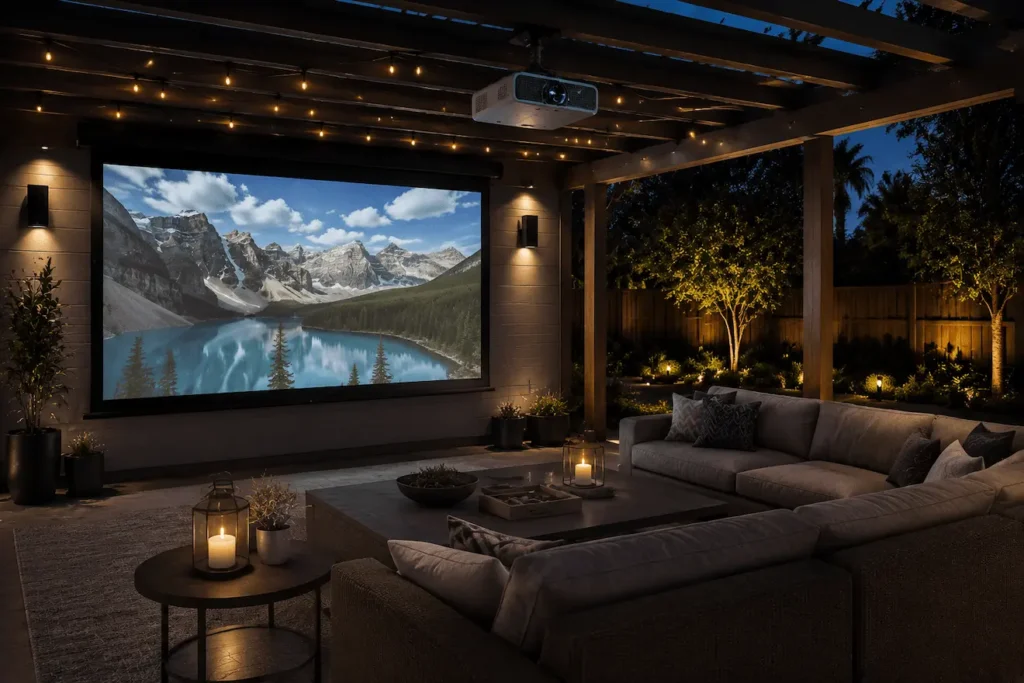
Weatherproofing: What Actually Survives Outside
Standard indoor electronics were never built to survive humidity, direct sun, or seasonal temperature swings, and any outdoor cinema setup needs genuinely weatherproof components on both sides of the equation, projector or panel, to hold up under an Austin summer followed by an occasional winter freeze. Treating either category as optional weatherproofing is how equipment fails within a single season.
Outdoor rated TVs use sealed housings, UV resistant screen coatings, and internal components built to handle heat that would degrade a standard indoor panel within months. This is a meaningfully different product category than an indoor television simply placed under a covered patio, even though both might look similar at a glance.
Projectors face a different challenge, since the unit itself typically needs a fully covered, weather protected location regardless of screen material, while the projection screen fabric needs its own outdoor rated construction to resist mildew and sun damage over years of exposure. An outdoor cinema setup built around projection succeeds or fails largely on how seriously this protection gets taken during planning.
Mounting and Placement for an Outdoor Screen
Mounting height and angle change meaningfully once an outdoor cinema setup lives outside rather than in a climate controlled living room. A large-format TV needs a mount rated for outdoor exposure, positioned to minimize direct sun hitting the screen face during peak viewing hours, since even a sun resistant panel performs best out of harsh direct glare.
Projector placement demands even more precision, since throw distance and screen size are locked together by the specific unit’s optics. Getting this measurement wrong during planning means either a screen that undersells the equipment’s actual capability or an image that overshoots the intended viewing area entirely, wasting resolution and brightness in the process.
This is exactly why Homeva takes this as the kind of decision that benefits from professional placement planning rather than guesswork. We measure throw distance, sun angle, and seating position together before a single bracket goes up, since a screen mounted based on convenience rather than actual viewing geometry rarely delivers the picture quality the equipment is actually capable of.
Cable Management Outdoors Is a Different Problem Entirely
Cable management indoors mostly concerns hiding wires for a clean look. In an outdoor cinema setup, it becomes a genuine weatherproofing and safety concern, since exposed cable runs face direct sun, moisture, and temperature swings that indoor rated cable and connectors were never built to withstand over years of use.
Conduit rated for outdoor and underground use protects power and signal cable from exactly this kind of degradation, routing everything cleanly from an indoor equipment closet or protected enclosure out to the screen location without a single exposed run baking in Texas summer sun. This matters as much for longevity as it does for the finished look of the installation.
Weatherproof connection points deserve equal attention. Any junction where cable meets a TV, projector, or amplifier needs a rated outdoor enclosure to keep moisture and insects out of the connection over time, since a single compromised connector is often the actual point of failure in an outdoor cinema setup that otherwise used quality components everywhere else.
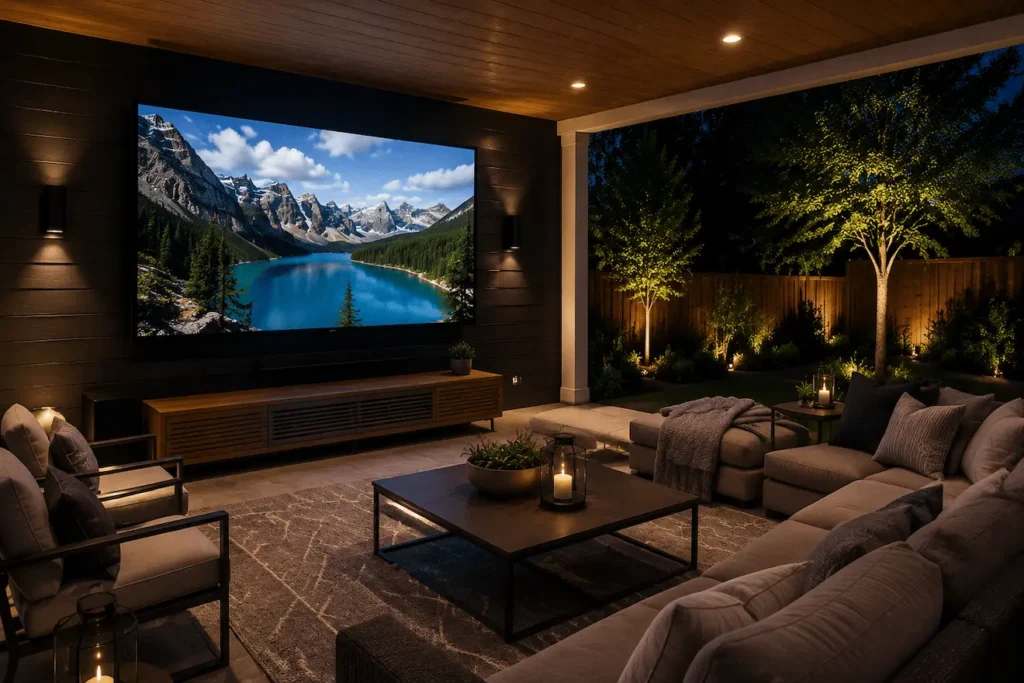
Screen Size and Viewing Distance for a Real Backyard
Screen size decisions in an outdoor cinema setup follow different math than an indoor living room, since seating distance in a backyard tends to be more flexible and often considerably farther from the screen than an indoor setup allows. This actually favors larger screens in many outdoor spaces, since generous viewing distance accommodates a bigger image without anyone sitting close enough to notice pixel structure.
Projection genuinely shines here, since screen size scales with distance from the projector rather than the cost of the panel itself. A hundred and twenty inch projected image often costs meaningfully less than a large-format TV of the same size, which is exactly why projection remains the go to choice for anyone chasing a true theater sized image in an outdoor cinema setup.
Large-format TVs still make sense at sizes most families actually use, typically somewhere between seventy five and one hundred inches, especially in spaces used during the day where a projected image simply is not viable regardless of budget. Matching screen size to actual seating distance and daytime usage patterns matters more than chasing the biggest number available.
Sound Deserves Its Own Plan, Not an Afterthought
A stunning picture undersold by weak built in speakers is one of the most common disappointments in an outdoor cinema setup. Both large-format TVs and projection screens benefit enormously from dedicated outdoor audio rather than relying on whatever speakers happen to be built into the display itself.
Weatherproof outdoor speakers, positioned correctly relative to seating, deliver the kind of clarity and coverage that turns a backyard movie night into something that actually feels cinematic rather than merely visible. This matters especially with projection, where the display itself typically has no meaningful built in audio at all.
Pairing picture and sound through one control system keeps the whole experience simple to actually use night after night. A single scene that brings up the screen, dims nearby lighting, and starts the right audio zone removes the friction that otherwise keeps a beautifully built outdoor cinema setup from getting used as often as it deserves.
Powering and Wiring the Setup Correctly From the Start
Power planning belongs at the very beginning of any outdoor cinema setup project, not as a detail worked out after equipment has already been chosen. Both projectors and large-format TVs need dedicated, properly rated outdoor circuits, positioned to keep connection points away from any area exposed to direct rain or standing water.
New construction and major landscaping projects offer the easiest path to getting this right, since conduit and outlets can be planned before hardscape and structure are finished. Retrofitting power and low voltage cable into an already finished yard is entirely possible, though it typically means more visible conduit or a more limited set of mounting locations to choose from.
Coordinating with whatever landscaping or patio construction is already underway avoids paying for a second disruptive phase of digging and wiring later. A conversation about screen location, power routing, and audio placement before concrete or pavers go down saves real money compared to retrofitting the same setup afterward.
Choosing the Setup That Actually Fits How You Entertain
The right outdoor cinema setup depends far more on how a family actually uses their yard than on which technology sounds most impressive on a spec sheet. A household hosting daytime pool parties needs something entirely different than one planning quiet evening movie nights under a pergola.
Getting this decision right means walking the actual space, understanding sun exposure at the hours it matters most, and being honest about budget rather than defaulting to whichever option a showroom happens to display prominently. That upfront honesty is what decides whether a setup gets used constantly or sits unused after the novelty wears off.
If you are ready to build an outdoor cinema setup that actually fits your Austin backyard, reach out to Homeva and we will walk your space to recommend the right TV or projection setup, paired with the audio that makes it feel complete.
FAQ
Is a projector or a large-format TV better for a backyard?
It depends on sun exposure. Shaded, mostly evening spaces favor projection for its scale and value, while sun-exposed areas used during the day need a large-format outdoor TV built for full sun visibility.
Can a regular indoor TV work outside if it is under a covered patio?
Not reliably long term. Even under cover, humidity and temperature swings degrade standard indoor electronics faster than outdoor rated components built specifically for that exposure.
How far should seating sit from an outdoor screen?
It depends on screen size and type, though outdoor spaces generally allow more flexible seating distance than an indoor room, which often favors a larger screen than most people initially plan for.
Does an outdoor cinema setup need its own dedicated audio system?
Yes, ideally. Built in speakers on a TV or the near total absence of sound from a projector rarely deliver a satisfying experience compared to dedicated outdoor speakers placed correctly for the seating area.
When should wiring for an outdoor screen get planned?
Before hardscape or major landscaping work finishes. Running conduit and power early avoids visible cable runs and expensive retrofitting once concrete or pavers are already in place.