
Smart mirror TV Austin homeowners choose for minimalist interiors solves the design problem that no amount of furniture arrangement fully resolves: a television is a large black rectangle that dominates the visual field of any room it occupies. When the screen is off, it sits on the wall like a void in the composition. When it is on, it becomes the room.
A smart mirror TV replaces that object with a mirror that is simply a mirror until the moment it is needed, at which point it becomes a display, and then returns to reflecting the room when viewing ends. The current generation of purpose-built mirror TV systems has reached a level where the result is genuinely invisible in a way that earlier iterations were not.
The principle behind a smart mirror TV is specific glass engineering rather than clever framing. A two-way mirror panel built from dielectric-coated glass allows the display to project through the glass surface while maintaining mirror reflectivity when the display is dark. This is what makes a smart mirror TV Austin homeowners specify different from anything a frame can accomplish.
Specification-grade panels balance at roughly 70 percent reflectance and 30 percent transmittance, requiring the display behind the glass to operate at significantly higher brightness than a wall-mounted television, typically 800 nits or above for a room with normal ambient lighting.
At Homeva, a smart mirror TV installation begins with the room and the wall, not the product catalog. Placement geometry, ambient lighting conditions, display brightness requirements for that specific location, and the integration path to the home’s control platform all need to be resolved before a glass panel or a display is specified. A smart mirror TV selected before its installation environment was understood produces a result somewhere between disappointing and invisible in the wrong sense of the word.
Two-Way Mirror Glass: The Smart Mirror TV Austin Foundation
The glass panel is the element that determines whether a smart mirror TV Austin installation reads as architecture or as a consumer product in a frame. Specification-grade dielectric two-way mirror glass is manufactured to optical clarity standards that eliminate the slight green or grey tint that lower-grade mirror glass produces, which is significant because any color cast in the glass shifts the white balance of the display behind it and affects how skin tones and neutral colors render during viewing.
Water-white optical glass, the standard used by manufacturers like Seura and Reflectel in their residential mirror TV products, produces a neutral reflective surface that does not alter the color rendering of the display.
Glass thickness affects reflective quality and structural requirements at large formats. A residential mirror TV at 55 to 65 inches uses glass in the range of 6 to 8 millimeters, providing adequate rigidity without excessive weight. At 75 inches and above, the combined weight of glass and display becomes a meaningful structural consideration.
Frame selection is the aesthetic decision that most directly affects how the smart mirror TV Austin installation integrates with the room’s design language. A frameless installation, where the glass edge is polished and the display matches the glass exactly, produces the cleanest result for contemporary and minimalist interiors.
A slim metal edge in brushed nickel, matte black, or oil-rubbed bronze coordinates with the room’s primary hardware tone. A wider decorative frame suits transitional or traditional interiors where the mirror is expected to carry the character of a framed piece rather than disappear into the wall. Our smart mirror services approach the frame decision as a finish specification, not a product selection.
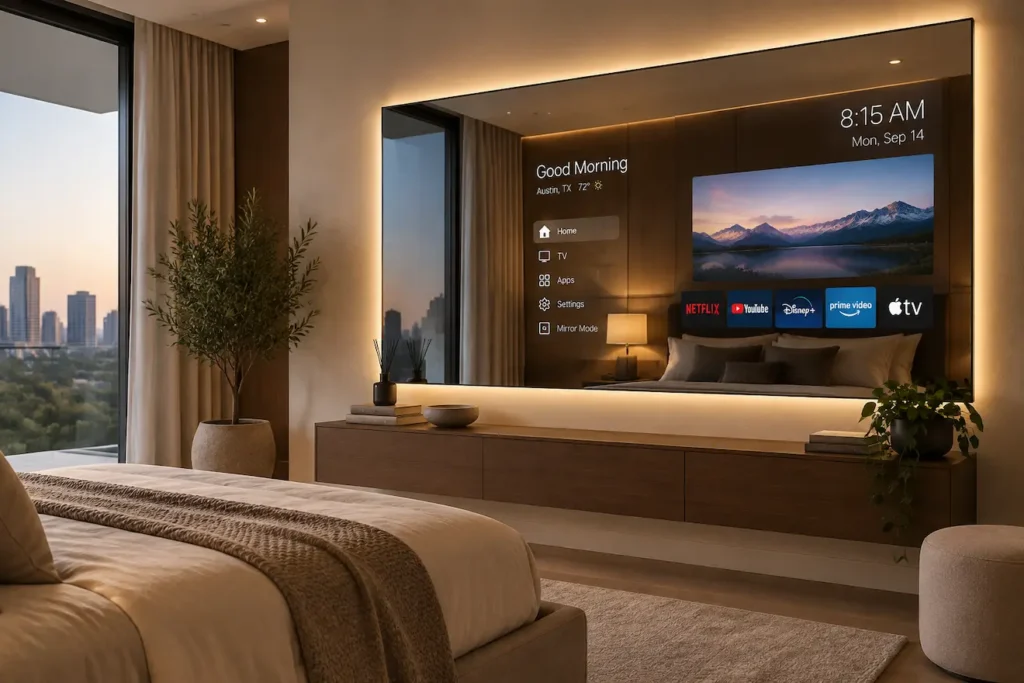
Display Selection for Smart Mirror TV Austin: Brightness and Heat Management
The display behind a two-way mirror panel is not a standard wall-mounted television. The glass transmits approximately 30 percent of the display’s output, so a display at 400 nits produces roughly 120 nits of effective brightness through the glass. In a bathroom or primary suite where ambient lighting can be controlled during viewing, lower brightness is workable.
OLED displays offer advantages for smart mirror TV installations that matter in a minimalist context. Each pixel extinguishes individually rather than relying on a backlight that bleeds, meaning the off-state of the display is a true absence of light rather than a faint grey glow. A backlit LCD at minimum brightness still produces some light leakage through the mirror panel, giving the glass a faint illuminated appearance in dim conditions.
An OLED is simply dark when off, which means the mirror reads as a mirror. The trade-off is heat management: OLED panels in enclosed enclosures behind mirror glass require ventilation planning to prevent thermal throttling over time.
For bathroom installations where vapor exposure is a factor, the display must include appropriate ingress protection. A smart mirror TV Austin installation directly above a vanity in a primary bathroom requires an IP54-rated display at minimum, protecting against water spray and condensation. Installations in wet areas near a shower or freestanding tub require IP65 or above.
These ratings are not interchangeable with general consumer television waterproofing claims; the IP rating system has a specific test methodology, and the display’s rating documentation should be reviewed against the specific installation environment before specifying.
Placement and Ambient Lighting: The Variables Most Installations Get Wrong
Placement of a smart mirror TV Austin installation involves the display’s viewing geometry, the ambient lighting of the room, and the reflective behavior of the glass relative to light sources in the space. These variables interact in ways that become apparent only after installation if they are not addressed in the planning phase, and the results of getting them wrong, a washed-out picture during daylight, distracting ceiling fixture reflections in the glass, or a mirror that does not reflect naturally when the display is off, are difficult to remedy after the installation is complete.
The viewing geometry begins with the primary viewing position and the angle at which the display sits relative to it. A bathroom mirror TV above a vanity is viewed from close distance at a neutral angle. A bedroom mirror TV at the foot of the bed may require a slight downward tilt to place the display center at the viewer’s eye level when reclined.
A living room mirror TV on a feature wall needs to account for the viewing distance and the range of seating positions that will use it. Treating all mirror TV placements as equivalent produces installations that are comfortable for one viewing position and awkward for all others.
Ambient lighting is the variable that most directly affects viewing quality in a smart mirror TV Austin installation and that needs to be addressed at the design phase rather than after. Ceiling downlights directly in front of the mirror glass create specular reflections that compete with the display during viewing.
The solution is not to eliminate overhead lighting but to position it so its reflection falls outside the primary viewing axis. Sconces or vertical vanity lighting on either side of the mirror avoids the overhead reflection problem while providing the dimmable ambient light that makes the display most readable.
Smart Home Integration: How Smart Mirror TV Austin Systems Work as One
A smart mirror TV Austin installation that operates only through its own remote or a dedicated app is a convenience upgrade. A smart mirror TV that responds to the same keypad, voice command, or scene trigger that manages the room’s lighting, shade position, and audio is a system, and the difference in daily experience between the two is the difference between a gadget and an integrated environment.
The integration path for a smart mirror TV Austin project depends on the display platform running inside the mirror and the control architecture already in the home. Displays running Android TV or the Seura Smart platform can communicate with home automation processors through IP-based interfaces, allowing the display to be addressed as part of a Lutron-based scene.
A “Morning” scene in a primary bathroom might raise the motorized shade to 30 percent, warm the mirror’s perimeter lighting in Austin, and power on the display to a news or weather input, all from a single keypad press. An “Evening” scene reverses those conditions and powers the display off as part of a wider bedroom wind-down sequence.
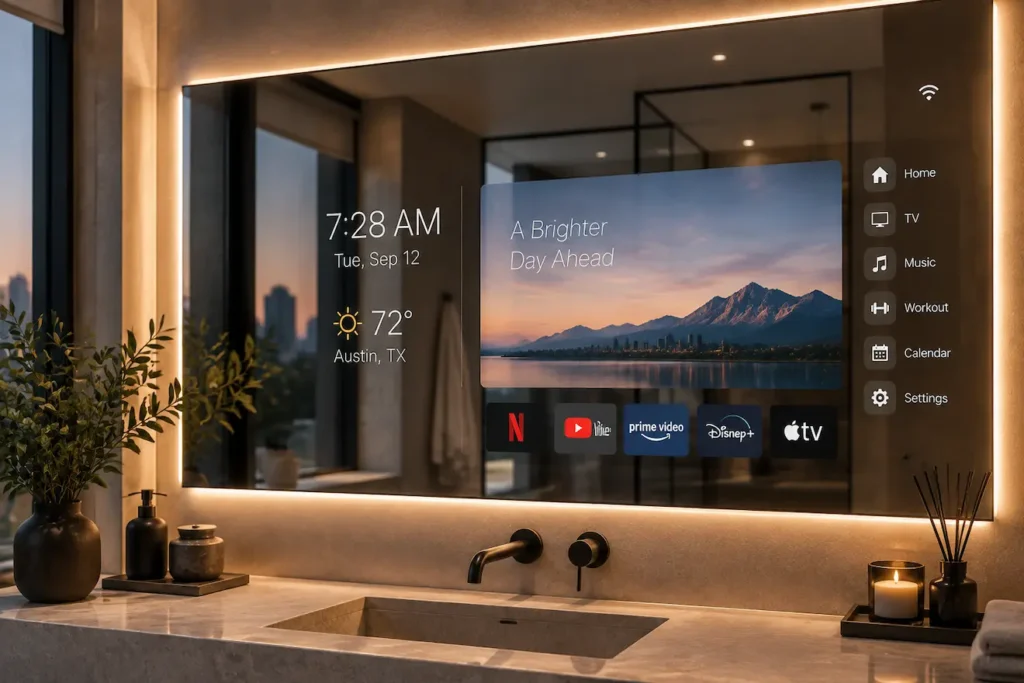
Smart Mirror TV Austin Installation in a Finished Interior
A smart mirror TV Austin installation in a completed luxury interior is more constrained than a new-construction specification, and the constraints are worth understanding before a product is ordered. The display and glass panel together represent a significant weight, typically 80 to 150 pounds for a 55 to 65-inch installation, requiring anchoring into structural members rather than drywall alone.
In a primary bathroom with cement board over studs and tile, identifying stud locations and tile depth before designing the mounting system is a prerequisite, not a site condition to address during installation.
The electrical supply needs to be routed invisibly, and it is one of the areas where smart mirror TV Austin projects require careful pre-installation planning. A power outlet recessed into the wall behind the glass panel, with the cable completely concealed within the wall cavity, produces a result where no cable is visible from any viewing position.
Achieving this in a completed space requires identifying the cable path from the nearest electrical source and confirming it is accessible without opening finished surfaces beyond the area the mirror will conceal. A smart mirror TV installation where cables route behind the glass and are visible through the transparent areas of the panel is a detail failure that undermines the entire premise of the product.
If the smart mirror TV is the solution to the television problem your renovation has been carrying, connect with Homeva and we will bring the full specification conversation to your space before a single hole is drilled.
FAQ
How does a smart mirror TV Austin installation work when the display is off?
When the display is off, the two-way dielectric glass reflects the room in front of it exactly as a conventional mirror would. The display behind the glass produces no light, which means there is no visible evidence of the television under normal ambient lighting.
What size display does a smart mirror TV Austin installation require?
The display must be sized to match the viewable area of the mirror panel, the full glass dimension for frameless installations or the interior aperture for framed versions. Manufacturers like Seura offer integrated units where the display and glass are factory-matched to eliminate sizing discrepancies.
Can a smart mirror TV be installed in a bathroom near a shower?
Yes, with the appropriate display specification. Installations near showers or tubs require displays with an IP65 or above ingress protection rating. Displays above a vanity without direct water exposure require a minimum IP54 rating. These ratings must be confirmed in the product documentation, not inferred from marketing language.
How bright does the display need to be in a smart mirror TV Austin installation?
The glass transmits approximately 30 percent of the display’s output, so a display at 400 nits produces roughly 120 nits of effective brightness through the glass. For a room with normal ambient lighting, the display should operate at 800 nits or above. For a dimmable bathroom or bedroom where ambient light can be controlled, lower brightness is acceptable.
Does a smart mirror TV integrate with Lutron lighting control?
Yes, when the display platform supports IP-based control through a home automation processor. Displays running Seura Smart or Android TV with the appropriate integration drivers can participate in Lutron scenes, allowing the mirror TV to power on or off and control volume as part of a broader scene triggered from a single keypad press.
What distinguishes a smart mirror TV Austin installation from a standard television in a frame?
A smart mirror TV uses two-way dielectric mirror glass to make the display invisible when off. A framed television is always identifiable as a television because the panel surface is visible regardless of the frame’s quality. The smart mirror TV is a fundamentally different product: the glass is the primary visual element, and the television is concealed within it.