
Dark sky lighting Austin homeowners navigate sits at the intersection of genuine regulatory requirements, ecological responsibility, and the practical demands of a well-lit luxury property. The Hill Country communities directly west of Austin, including Dripping Springs, Bee Cave, and Wimberley, are certified International Dark Sky Communities with enforceable residential lighting ordinances.
Austin proper references the IES/IDA Model Lighting Ordinance in its Building Criteria Manual, and the spread of dark sky standards means that homeowners in newer developments near wildlife corridors, or anywhere west of Mopac, increasingly encounter these requirements in deed restrictions and HOA covenants even when city ordinance does not mandate them directly.
The technical requirements are specific. Dark sky compliant exterior lighting must use full-cutoff fixtures that emit zero light above the horizontal plane, preventing the upward scatter that creates skyglow visible miles from developed areas. Fixtures must be at or below 3,000K correlated color temperature, with 2,700K the practical standard for residential installations.
Hill Country jurisdictions cap residential properties at 25,000 lumens per acre total, a limit that sounds generous until a full exterior specification, driveway, motor court, landscape, pool deck, and facade, is totaled against it. The 3,000K ceiling catches homeowners off guard most often: consumer warm white LEDs commonly ship at 4,000K or 5,000K, which are non-compliant regardless of how they are shielded.
At Homeva, the dark sky lighting Austin conversation begins during specification, not after installation. The compliance questions for a property in Dripping Springs or near one of the Hill Country corridor developments that have adopted dark sky covenants are different from the questions for a property inside Austin city limits, where compliance is more voluntary but increasingly expected as a marker of environmental and community responsibility.
What Full-Cutoff Fixtures Mean for Dark Sky Lighting Austin Projects
Full cutoff is a precise optical classification defined by the Illuminating Engineering Society. A fixture meets the full-cutoff standard when it produces zero intensity at or above ninety degrees from nadir, meaning no light whatsoever travels upward from the fixture.
This is a harder requirement than it sounds: a standard recessed downlight in a soffit may appear to point downward but can still produce upward light scatter from the housing opening, the reflector geometry, or the lens surface. True full-cutoff fixtures are engineered with optics that contain the entire light distribution within the lower hemisphere, often using precision reflectors and secondary lenses that define a clean cutoff at the fixture’s horizontal plane.
The aesthetic implications are significant for luxury residential projects. Full-cutoff fixtures cannot produce the upward wall-wash that many architectural designs rely on for facade articulation. A wall-grazing fixture striking stone from above and creating shadow patterns that define material texture is, by definition, directing light upward and is non-compliant.
The design discipline that dark sky lighting Austin projects require is achieving the same visual results through downward and horizontally controlled sources: pathway lighting with downward-facing shrouded heads, landscape lighting with precisely aimed ground-level sources, and architectural accent fixtures with baffles that create the illusion of wash without actual upward emission.
Fixture selection requires reviewing photometric reports and BUG ratings rather than relying on product claims alone. The IES BUG system scores a fixture on Backlight, Uplight, and Glare. A compliant fixture should carry a U0 uplight rating alongside appropriate backlight and glare ratings for its installation context.
Fixtures carrying the DarkSky Approved label have been independently verified to meet these standards, simplifying the specification process where compliance documentation is required.
Color Temperature: The Dark Sky Lighting Austin Standard You Cannot Ignore
The restriction on color temperature is not aesthetic guidance; it is based on the spectral composition of light and its environmental effect. Short-wavelength blue light, which dominates at higher color temperatures, scatters more readily in the atmosphere than the longer-wavelength amber produced at 2,700K or below.
That scattering creates skyglow over developed areas, disrupts nocturnal wildlife behavior in the Hill Country ecosystems adjacent to Austin’s western suburbs, and suppresses human melatonin production at intensities far below thermal discomfort.
For a homeowner specifying exterior lighting at 4,000K or 5,000K because those products looked appealing in a showroom, the practical consequence in a dark sky jurisdiction is non-compliance that cannot be remediated by dimming or shielding.
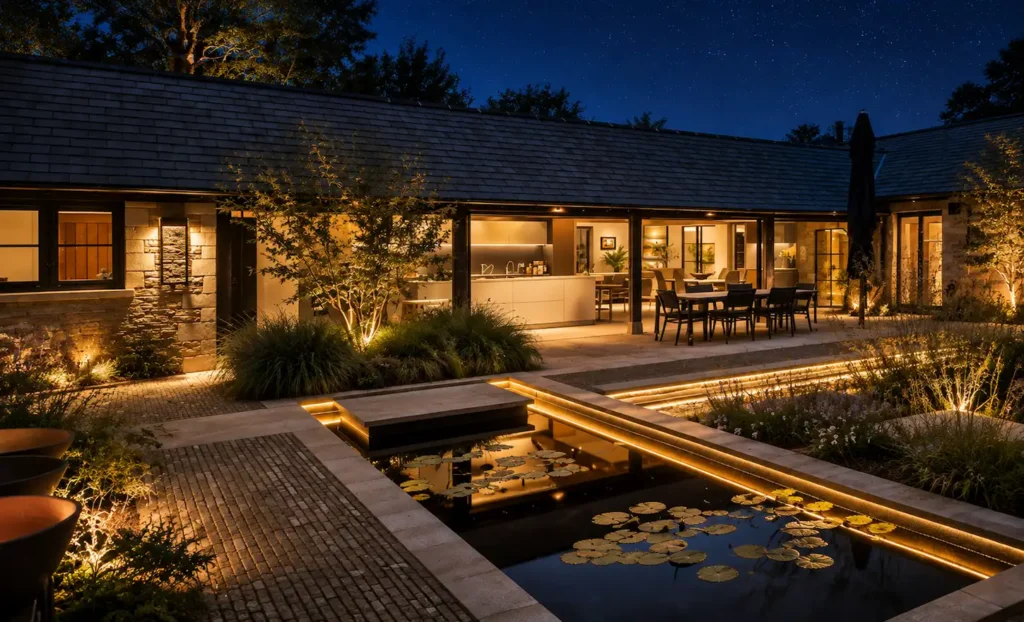
At the residential level, 2,700K is the practical specification standard where dark sky lighting Austin compliance and visual quality need to coexist. At 2,700K, exterior lighting produces a warm amber tone that reads as sophisticated and intentional against stone, wood, and stucco facades, and that photographs well in the evening hours when a home’s exterior presence is most visible from the street.
The 3,000K ceiling provides some specification flexibility for functional areas like motor courts and entry walks where cooler, higher-CRI light may be preferred for safety and visibility, but the 2,700K target is the one that consistently satisfies both the ordinance intent and the homeowner’s visual expectations for a premium exterior.
Dark Sky Lighting Austin Automation: Schedules, Dimmers, and Curfew Controls
A dark sky compliant fixture specification solves the hardware side of the problem, but dark sky lighting Austin compliance is equally a behavioral question. The behavioral side requires automation. Dark sky ordinances in Texas communities typically include curfew provisions that require non-essential exterior lighting to be reduced or extinguished after a defined hour, commonly 11 p.m. or midnight, for residential properties.
Permanent pathway lighting, security-triggered response fixtures, and certain entry lighting may be exempted from curfew requirements, but the bulk of decorative and landscape lighting is subject to them. Without automation, a homeowner who has invested in compliant fixtures must remember to manually extinguish or reduce exterior lighting at the appropriate time, every night, or rely on individual timer controls on each circuit that are difficult to adjust seasonally.
A properly integrated dark sky lighting Austin automation system addresses the curfew requirement as a scene behavior rather than a manual task. A schedule programmed into the control platform brings all non-essential exterior circuits to zero at the curfew time automatically.
Security-triggered lighting activates on occupancy detection and returns to off after a defined duration, requiring no homeowner action. Pathway and entry lighting holds at reduced output after curfew to satisfy code exemptions without the full brightness load of the evening specification. Our automated home lighting services treat curfew scheduling as a standard configuration element.
Dark Sky Lighting Austin Security: Motion Detection Without Skyglow
Security lighting is one of the most common sources of dark sky non-compliance in residential projects, not because homeowners are indifferent but because security and night sky preservation are often framed as competing goals. The assumption that security requires maximum brightness and full-time illumination is not accurate.
Dark sky compliant security lighting can deliver the same detection and deterrence benefits without the constant light load that contributes to skyglow and neighbor nuisance.
The most effective dark sky lighting Austin approach to security combines occupancy-triggered, full-cutoff downlights that activate on detection with a baseline ambient that keeps the property from going completely dark during occupied hours. The triggered response provides the sudden increase in light level that is most effective as a deterrent, while the baseline ambient maintains the situational awareness that a completely dark exterior perimeter does not allow.
The triggered fixtures in Austin are compliant because they are full-cutoff and 3,000K or below; they are acceptable under curfew provisions because they are occupancy-activated rather than continuously on; and they do not contribute to sustained skyglow because they return to off after the detection period ends.
Camera placement interacts directly with exterior lighting specification in ways rarely addressed until the security system is commissioned. A camera that depends on a flood to illuminate its field of view is a different problem than one designed for low-light performance.
In a dark sky compliant project where flood lighting is not appropriate, specifying cameras with the appropriate sensitivity for the ambient light conditions produces a better security outcome and a more compliant lighting result simultaneously.
Planning Dark Sky Lighting Austin Projects Before the Fixtures Are Ordered
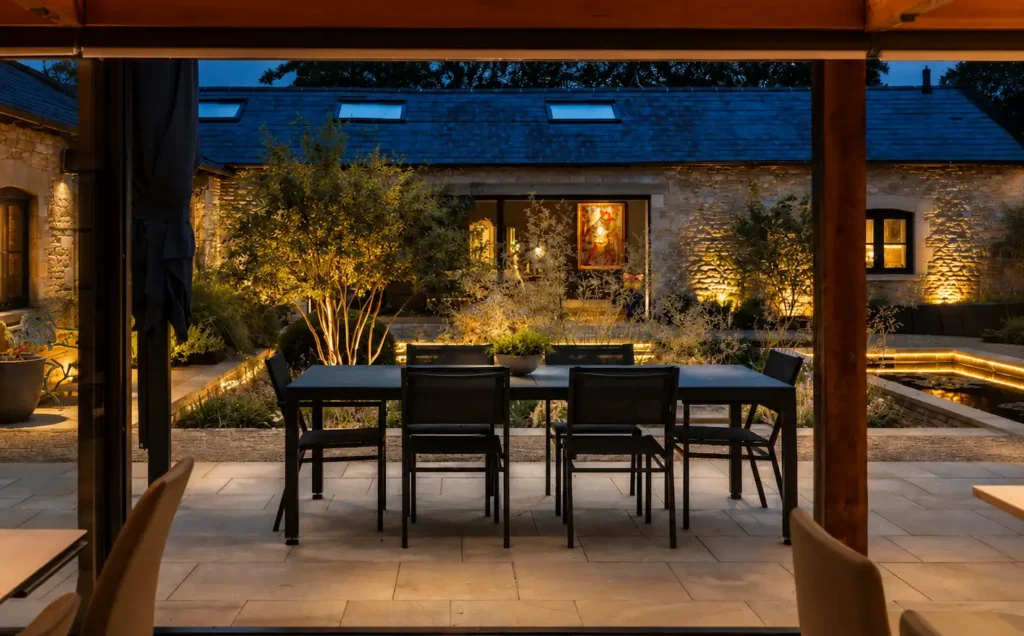
The most common mistake in dark sky lighting Austin projects is treating compliance as a fixture attribute rather than a system design discipline. A compliant fixture installed at the wrong location, aimed at the wrong surface, or operating on a schedule that leaves lights on through the night is not a compliant installation regardless of the fixture’s certification status.
The fixture is necessary but not sufficient; the system, meaning the placement geometry, the photometric plan, the output levels, the control architecture, and the operational schedule, is what determines whether the property actually meets the standard.
Photometric planning is the dark sky lighting Austin tool that reveals compliance issues before any hardware is purchased, modeling light distribution and calculating total lumen output against the site’s area. A photometric plan for a large lot identifies where the lumen budget is being consumed, which zones are contributing to uplight due to placement or surface reflection, and where the specification needs adjustment. This is the planning step that most consumer-grade exterior projects skip and that most compliance failures trace back to.
For Austin homeowners whose properties fall within or adjacent to dark sky jurisdictions, the dark sky lighting Austin specification and automation conversation needs to happen before fixture selection, not after. Connect with Homeva and we will assess your specific property conditions, identify the applicable standards, and design an exterior lighting system that meets those standards without compromising the visual quality your home deserves at night.
FAQ
Do Austin homeowners have to comply with dark sky lighting Austin ordinances?
Properties in certified Dark Sky Communities near Austin, including Dripping Springs, Bee Cave, and Wimberley, are subject to enforceable ordinances. Properties inside Austin city limits are not subject to mandatory residential requirements at this writing, though commercial projects reference the IES/IDA Model Lighting Ordinance. Many newer developments and deed-restricted communities have adopted dark sky standards as private covenants that are contractually binding regardless of municipal ordinance.
What is the maximum color temperature for dark sky compliant exterior lighting?
Most dark sky ordinances, including those in Hill Country communities near Austin, set 3,000K as the maximum correlated color temperature for exterior fixtures. The practical standard for luxury residential projects is 2,700K, which produces a warmer, more aesthetically refined light and provides a comfortable margin below the regulatory ceiling.
What does full-cutoff mean for a light fixture?
Full cutoff is an IES classification meaning the fixture produces zero light intensity at or above ninety degrees from nadir, the straight-down vertical. In practical terms, it means no light escapes upward from the fixture. This is verified through the fixture’s photometric report and BUG rating, where a U0 uplight rating confirms full-cutoff performance.
Can I achieve dark sky compliance without replacing all my exterior fixtures?
Possibly, if existing fixtures meet the full-cutoff and color temperature standards and the total lumen output of the system falls within the applicable cap. If any fixtures produce uplight or exceed 3,000K, replacement is the only path to compliance because those characteristics are fixed in the hardware and cannot be corrected through controls, dimming, or shielding alone.
How does automation help with dark sky lighting Austin compliance?
Automation enforces the behavioral requirements that fixtures alone cannot: curfew schedules that extinguish non-essential lighting at the required time, dimming profiles that manage lumen output within the applicable cap, and occupancy-triggered security responses that provide light when and where it is needed without sustained nighttime illumination. A property with compliant fixtures and no automation is still a compliance risk if the lights run through the night.
What is a lumen cap and does it apply to residential properties near Austin?
A lumen cap limits total exterior light output per acre. In jurisdictions like Dripping Springs, the residential cap is 25,000 lumens per acre. Meeting it requires a photometric plan that tallies every fixture’s output against the property’s area, which is why professional specification matters for dark sky compliant exterior lighting.