
Quiet shade motors matter in a bedroom in a way they simply do not in a kitchen or a hallway. A shade that whirs, clicks, or grinds on its way up might go unnoticed during the day, but the same sound at five in the morning, right as a schedule triggers before sunrise, is enough to wake a light sleeper or a toddler down the hall.
Most people never think about quiet shade motors until they already own a system that makes noise. A shade demoed in a bright, busy showroom sounds silent enough, since the room itself covers up a low hum or a faint mechanical whine. That same motor installed above a headboard, in a room built for absolute quiet at night, tells a very different story once the lights go off.
At Homeva, we test every shade motor we spec in the actual conditions it will operate in, not a showroom floor. A motor built for a living room window rarely holds up to bedroom expectations, where even a barely audible sound becomes obvious the moment the house goes still and everyone is trying to sleep.
Getting this right means understanding what actually separates a quiet motor from a loud one, how the wiring behind a shade affects the sound it makes, and why a bedroom deserves a different specification than the rest of the house. The sections ahead walk through exactly that, starting with why bedrooms carry a different bar entirely.
Why Bedrooms Carry a Different Standard for Noise
A living room in Austin absorbs noise constantly, background music, conversation, a television running in the next room, all of it masking a shade motor that might otherwise draw attention. A bedroom offers none of that cover. Once the lights go out, a house reaches a baseline of quiet that makes even a soft mechanical sound stand out immediately.
This matters most at the exact moments automation tends to run, early morning wake schedules, late evening privacy closures, or a scene triggered in the middle of the night for a bathroom trip. Quiet shade motors are the difference between a system a family barely notices and one that interrupts sleep on a schedule nobody asked for. That gap only grows more obvious the longer a family lives with the wrong motor.
Children’s rooms raise the stakes further. A toddler roused by a clicking motor at six in the morning does not go back to sleep easily, and a nursery automated without this consideration in mind can undo months of a family’s hard won sleep routine in a single week. Bedroom automation has to earn trust quietly, or it stops getting used at all.
What Actually Makes a Shade Motor Quiet
Motor type is where quiet shade motors start to separate themselves from ordinary ones. DC motors run smoother and quieter than older AC driven motors, since they draw power more efficiently and produce far less vibration through the tube the shade fabric wraps around. This single difference in motor architecture explains most of the gap between a whisper quiet shade and one that hums audibly.
Gear construction plays an equally large role in whether quiet shade motors actually stay quiet over time. Motors built with precision cut, tightly toleranced gears produce less friction and less mechanical noise than cheaper stamped gear assemblies, which tend to rattle slightly even when new and grow louder as they wear.
Tube diameter and mounting also shape what a family actually hears from quiet shade motors. A motor mounted in an oversized tube with proper acoustic dampening transmits far less vibration into the wall or window frame than one crammed into an undersized tube without any buffer. This is a detail easy to overlook on a spec sheet, though it is often the difference between silent and merely quiet in a real bedroom.
Hardwired Power and the Sound You Actually Hear
Quiet shade motors depend heavily on power delivery. Hardwired shade motors benefit from a steady, consistent voltage supply that battery power simply cannot replicate over time, and a motor drawing power at a stable 24 or 30 volts runs at a consistent speed and torque that keeps operation smooth.
Battery powered motors, by contrast, draw down gradually between charges, and a motor working harder against a weakening battery often produces more strain noise than the same motor running on hardwired power. This is rarely mentioned by anyone selling a battery system as the easier install, though it is a real factor in how quiet a shade stays over its actual lifespan.
This is exactly why hardwired planning matters so much for quiet shade motors in a bedroom specifically. Running proper low voltage wiring during framing on new construction, or before walls close on a remodel, means every bedroom window gets clean, stable power from day one rather than a battery powered compromise chosen for convenience during installation.

Battery and RF Motors: Where Compromises Creep In
Battery shades absolutely have a place, particularly in rooms where running new wiring is impractical or in a retrofit where opening walls is not on the table. Quiet shade motors still exist in battery form, though the tradeoff is real and worth understanding honestly before choosing this route for a bedroom specifically built around quiet.
RF controlled battery motors introduce a second consideration beyond power delivery. Signal strength and interference can affect how smoothly a motor responds to a command, and a motor that hesitates or stutters before engaging tends to produce a small mechanical jolt that a hardwired, hub connected motor simply does not experience in the same way.
None of this means battery power is a poor choice everywhere in a home. It means a bedroom, specifically, is the room where quiet shade motors matter most, and where spending the extra effort on hardwired planning during construction pays off every single night rather than only occasionally.
The Real Difference Between Quiet and Actually Silent
Marketing language around quiet shade motors uses the word quiet loosely, and there is a meaningful gap between a motor that is quiet compared to older technology and one that is genuinely silent in a still bedroom at night. A motor rated as quiet on a spec sheet may still produce an audible hum that a light sleeper notices immediately once the house goes dark.
This is why relying on marketing claims alone rarely tells the full story. What actually matters is how a specific motor performs once installed in the exact wall, tube, and mounting configuration a bedroom requires, not how it performed in a manufacturer’s test lab under different conditions entirely.
We install and live with the motors we specify, which is how we know which ones hold up to a genuinely quiet bedroom rather than just a quiet showroom demo. That kind of firsthand testing is the only way to separate a motor that sounds good on paper from one that actually disappears into a sleeping household.
Why We Specify Lutron for Bedroom-Grade Quiet
Lutron built its reputation on precision engineering long before smart home automation became mainstream, and that engineering discipline shows clearly in how quiet their shade motors run compared to lower tier alternatives on the market. The DC motor technology inside a Lutron shade is built specifically to minimize vibration and mechanical noise at every stage of operation.
Beyond the motor itself, Lutron’s broader ecosystem lets shades, lighting, and climate work from the same programming logic, which matters for bedrooms where a single scene often needs to lower a shade, dim a light, and adjust temperature together without any one part of that sequence drawing attention to itself.
This is why Homeva specifies Lutron for bedroom projects specifically, not out of habit but because we have tested the alternative and seen the difference firsthand in real homes at two in the morning. Quiet shade motors are not a marketing checkbox for us, they are a requirement we hold every bedroom installation to.
Scheduling Shades Around Sleep Without Waking Anyone
A well planned schedule for quiet shade motors accounts for exactly when a family sleeps, not a generic sunrise and sunset trigger applied uniformly across every room in the house. A scene built around a household’s actual sleep pattern can lower blackout shades before bed and gently open them well after everyone is naturally awake, rather than on a rigid clock that ignores how people actually live.
This matters most for households with mixed sleep schedules, a parent waking early for work while children sleep in, or a night shift worker sleeping through the middle of the day. Quiet shade motors make this kind of individualized scheduling possible without anyone in the house being disturbed by a shade moving on someone else’s schedule.
Manual override deserves the same quiet standard as automation. A shade adjusted by hand in the middle of the night, for a bathroom trip or a restless moment, should move just as smoothly and silently as one triggered by a programmed scene, which is only possible when the underlying motor was chosen correctly from the start.
Pairing Quiet Shades With Bedroom Lighting and Scenes
A bedroom scene rarely involves shades alone. Pairing quiet shade motors with dimmed lighting and a consistent wake routine means a scene can gently bring a room from dark to lit over several minutes, shades included, without any single component announcing itself with noise or an abrupt transition.
We build our motorized shades to integrate cleanly with bedroom lighting scenes, so a wake up sequence feels like a gradual, natural shift rather than several disconnected devices firing off one after another. That kind of integration is where quiet motor technology and thoughtful programming reinforce each other rather than working in isolation.
Nursery and children’s room scenes benefit especially from pairing quiet shade motors this way, since a gentle wake sequence that includes soft light alongside a slowly rising shade tends to ease a child awake far more calmly than an abrupt shade movement or a light snapping on at full brightness without warning.
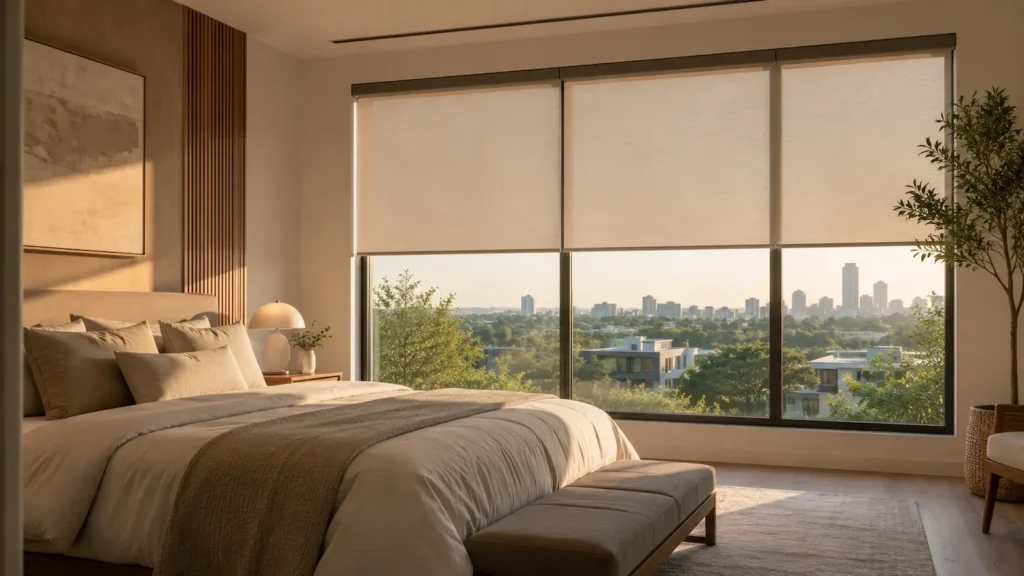
Keeping Motors Quiet for Years, Not Just on Install Day
Quiet shade motors that sound right on installation day should sound the same way five years later, and that consistency depends heavily on build quality rather than luck. Cheaper motors often start quiet and grow noisier as gears wear and tolerances loosen.
Routine maintenance stays minimal with a properly specified system, typically limited to an occasional check that mounting hardware remains snug and that nothing has shifted enough to introduce new vibration against a wall or frame. Systems built on lower tier motors tend to need far more frequent adjustment to stay quiet at all.
This is another reason hardwired power matters over the long run. A motor running on consistent voltage experiences less mechanical strain over years of daily cycling than one constantly compensating for a weakening battery, which translates directly into a system that stays quiet for the life of the installation rather than just the first year.
Choosing a Partner Who Treats Bedroom Automation Differently
Bedroom automation deserves a different specification than the rest of a home, and a system installed without quiet shade motors in mind often performs fine everywhere except the one room where quiet actually matters most. Getting this right means understanding motor technology at a level most installers never bother learning in detail.
This means walking through a family’s actual sleep patterns and expectations before recommending a single product, not applying a one size fits all shade specification across every room in the house regardless of its purpose. That difference is what decides whether bedroom automation gets used every night or gets overridden and eventually ignored.
If your Austin bedroom needs shades that actually disappear into a quiet night rather than announcing themselves at the worst possible moment, reach out to our team and we will walk through what genuinely quiet automation looks like for your specific space.
FAQ
Are all motorized shades loud enough to notice at night?
No, but many are louder than most homeowners expect once a bedroom goes fully quiet. Motor type, gear quality, and mounting all affect how audible a shade actually is once the lights are off.
Why does hardwired power matter for a quiet bedroom shade?
Hardwired motors run on steady voltage, which keeps speed and torque consistent and produces less mechanical strain noise than a battery motor working against a weakening charge over time.
Is battery power ever acceptable in a bedroom?
Yes, particularly in a retrofit where wiring is impractical. The tradeoff is worth understanding honestly, since hardwired motors generally stay quieter over years of daily use.
Why does Homeva specify Lutron for bedroom shades specifically?
Lutron’s DC motor engineering is built to minimize vibration and mechanical noise, and we have tested it directly against alternatives in real bedrooms rather than relying on spec sheets alone.
Can quiet shades be scheduled around an irregular sleep routine?
Yes. A schedule can be built around a household’s actual sleep pattern, including mixed schedules between family members, rather than a generic sunrise and sunset trigger applied to every room.