
Home audio Austin residents pursue is shaped by something most cities cannot claim: a daily reference point for what exceptional live sound feels like. Austin has been the live music capital of the world long enough that the phrase has become ambient, but the experience it describes is specific. ACL Live at the Moody Theater fills 2,750 seats with broadcast-grade acoustics that somehow still feel personal.
The Parish on 6th Street makes a mid-size room sound like it was designed for the instrument. The Continental Club on South Congress, open since 1955, delivers acoustic intimacy that is immediately legible to anyone who has spent time there. These are not abstract standards; they are weekly reference experiences that shape what home audio Austin homeowners expect indoors.
The gap between that experience and what most home audio Austin installations deliver is real, but it is not inevitable. Speaker placement, room acoustic treatment, amplifier quality, and calibration are all addressable in a residential context. The result of addressing them well is a system that does not remind you of a venue because it is trying to imitate one. It produces the same sensory experience for the simple reason that it was designed with the same discipline the best venues apply.
At Homeva, we approach home audio in Austin with the same seriousness that Austin’s music community brings to the live experience. The homes we work with range from open-plan great rooms in new construction to renovated midcentury properties with acoustic conditions shaped by decisions never made with sound in mind. In both cases the goal for home audio Austin is the same: music with the spatial honesty and dynamic range that makes it worth listening to, not as background, but as the point of being in the room.
What Austin Venues Get Right That Most Home Audio Installations Miss
The defining quality of a great live sound experience, and of great home audio Austin projects, is not volume; it is coherence. When acoustics and system work together properly, sound appears to come from the performance rather than from the speakers. The listening position receives a consistent frequency response across the room’s width and depth, without the hot spots and dead zones that result from poor placement or untreated reflections.
The bass is felt as well as heard, extending smoothly from the speakers’ low frequencies rather than peaking at one frequency and disappearing at others. This coherence is what the best home audio Austin installations prioritize above every other variable. It is also what the best home audio Austin installations prioritize above every other variable.
Speaker placement is where most residential audio fails first. The common approach is to distribute speakers evenly across the ceiling plane, treating the room as a grid rather than a listening environment. Professional acoustic design starts from the listening position and works outward: where are the primary seats, what reflective surfaces will the sound encounter before it arrives.
In-ceiling speakers tilted toward the listening position, at the appropriate distance and angle for the room’s dimensions, and calibrated to the room’s acoustic signature produce a fundamentally different result from speakers placed at convenient intervals without regard for what the room does to the signal between driver and ear.
Amplification is the variable luxury home audio Austin projects most consistently underspecify relative to the speaker investment. A pair of Sonance or Leon Speakers in-ceiling units will only perform as designed if the amplifier driving them has the headroom, signal-to-noise performance, and damping factor to let them work properly.

Architectural Speakers: Invisible Home Audio Austin Homes Demand
The assumption that in-ceiling or in-wall speakers are a compromise was accurate for a long time, and it is one of the most persistent misconceptions home audio Austin integrators still encounter. The architectural speaker category has undergone a genuine transformation: the best units from Sonance, Triad, Leon Speakers, and the Stealth Acoustics LineaRadiance family are voiced to match their freestanding counterparts using the same driver technology and crossover engineering.
The sonic difference between a well-specified in-ceiling speaker and a reference bookshelf speaker in an equivalent acoustic environment is now a matter of preference and placement rather than a categorical gap in performance.
Stealth Acoustics takes invisibility furthest with their LineaRadiance (L-RAD) series, which installs behind a finished wall or ceiling surface and is painted, wallpapered, or textured to match the surrounding material exactly. The speaker leaves no visible footprint, a capability that matters in spaces where the room’s design language has been established and any grille would read as an intrusion.
The distributed audio layer routing signal to architectural speakers across multiple zones is where Sonos has established itself as the residential standard for homes where quality and accessibility need to coexist.
The Sonos Amp, paired with Sonance or other passive architectural speakers, provides room-tuned calibration through Trueplay technology, which measures the room’s acoustic response and adjusts the equalization curve to compensate. For home audio Austin projects where the primary goal is excellent distributed audio rather than a dedicated listening room, this combination sets the performance baseline.
Room Acoustics: The Home Audio Austin Variable That Changes Everything
A room’s acoustic properties, specifically how it handles reflections, absorbs certain frequencies, and creates resonances, are not separate from the home audio Austin system; they are part of it. A speaker produces sound, and the room determines what arrives at the listening position.
This is the reason ACL Live invested in acoustic engineering rather than simply installing the most expensive speakers available, and it is the reason a thoughtfully specified home audio system in a room with untreated parallel walls and a hard floor can still disappoint while a more modest system in a room with appropriate treatment and a thoughtful layout can excel.
In a residential context, acoustic treatment does not mean covering walls in foam panels. It means understanding which frequency ranges the room reinforces or absorbs and introducing elements that address those issues without compromising the room’s visual character. A large area rug absorbs mid-frequency floor reflections. Upholstered furniture reduces high-frequency reverb.
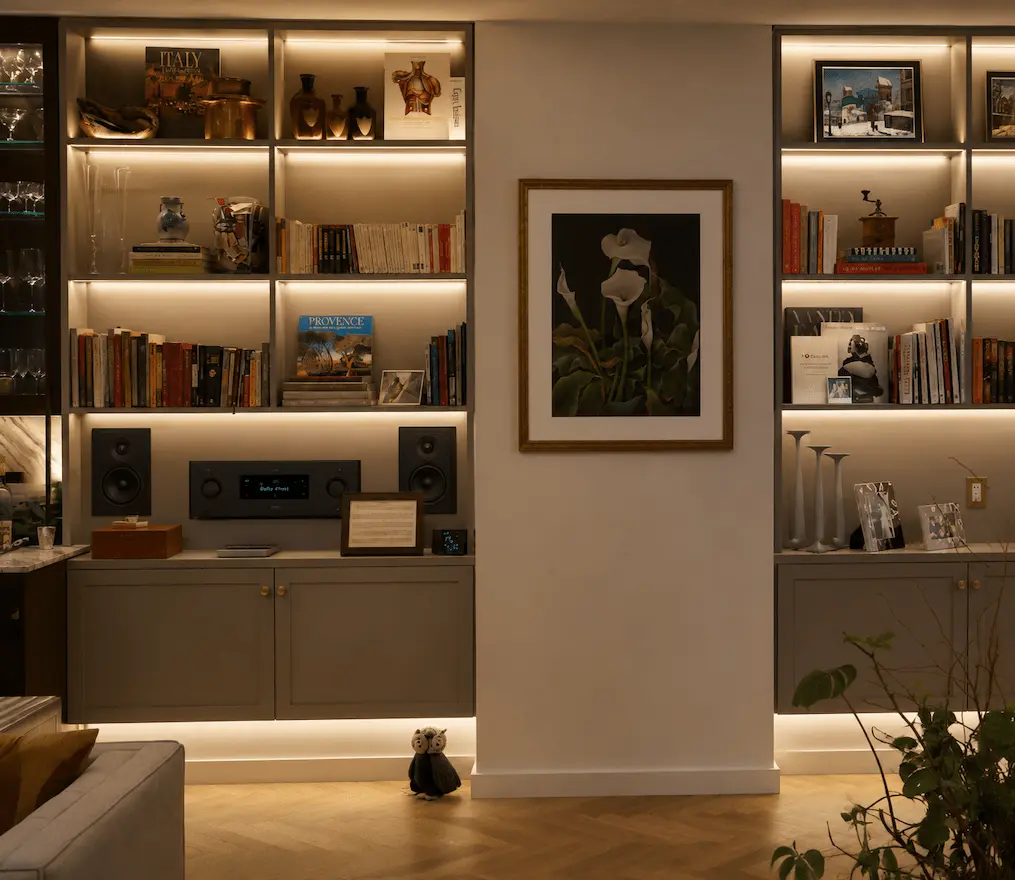
A bookcase with irregular surface depth diffuses rear wall reflections rather than returning them as a coherent echo. These are design elements that serve acoustic functions without announcing themselves as treatment, and in a well-designed home they are often already present. The audio specification needs to account for what the room already does.
New construction offers the most control over acoustic conditions, and the moment to address them is during the design phase. A home audio Austin project in a new build can specify wall assembly types, ceiling heights, and floor materials with their acoustic implications in mind alongside their aesthetic ones.
Concrete floors and glass walls create a reverberant environment requiring more intervention than a room with softer materials and more varied surface geometry. Knowing this at the design stage allows acoustic treatment to be integrated into the architecture rather than applied afterward.
Multi-Room Home Audio: Bringing the Whole Austin Home Into the Experience
The live music experience at its best is not contained in a single room. Austin’s best venues have a sound that extends from the main stage into the lobby and outdoor areas, maintaining continuity as you move.
A well-designed home audio Austin multi-room system creates the same quality: music that follows you from the kitchen through the dining room to the covered patio without a seam, calibrated for each space rather than distributed from a single signal path that treats every zone identically.
The technical architecture of a multi-room home audio Austin system determines the ceiling on what it can deliver. A single-zone system with high-performance speakers in the main room and generic audio elsewhere gives reference-quality sound in one space and fidelity that bears no resemblance to it everywhere else.
A properly designed distributed system specifies each zone independently: speaker placement, amplifier power, and acoustic calibration appropriate to the room’s dimensions and listening position. The great room needs a different specification than the primary bedroom, which needs a different one than the covered outdoor patio competing with ambient noise across a much larger acoustic volume. Our home audio services treat each zone as a distinct design problem.
Outdoor audio is where Austin’s climate creates a specification opportunity most markets do not have to the same degree. A covered patio in West Austin or Tarrytown that functions as a primary entertaining space for eight or nine months of the year is not a secondary zone.
Calibration: What Separates Good Equipment from Great Home Audio Austin Results
The gap between a collection of excellent components and a cohesive, high-performing system is calibration, and it is the most undervalued step in residential audio installation. A professional acoustic measurement identifies what the room’s transfer function does to the signal between the speaker and the listening position, and allows the integrator to apply correction that compensates for room-induced peaks and nulls rather than accepting them as fixed conditions.
Room correction software like Dirac Live, available in several residential amplifiers at the quality tier appropriate for home audio Austin luxury projects, applies a correction curve derived from acoustic measurements taken at multiple positions in the listening area.
The correction addresses time domain issues: the arrival of sound from different speakers or room reflections at slightly different times, which causes phase relationships that blur transients and reduce perceived clarity. Addressing these issues turns a system that measures well into one that sounds the way the best rooms sound, with spatial honesty and dynamic accuracy.
The calibration conversation belongs at commissioning, but the groundwork needs to be laid at the specification phase. Speaker positions need to be determined with acoustic measurement positions in mind. Amplifiers need to support the room correction software being used.
Subwoofer placement needs to account for the room mode frequencies that will need correction. Doing the calibration last is correct; planning for it first is essential. If your home audio system has never been professionally calibrated, connect with Homeva, and we will start with a measurement that tells you exactly where things stand.
FAQ
What makes Austin a good reference point for high-quality home audio design?
Austin’s live music culture gives residents regular exposure to professionally designed sound, from the broadcast-grade acoustics of ACL Live to the intimate clarity of smaller venues. That familiarity creates an unusually specific expectation for what good sound feels like, and it shapes what Austin homeowners expect from residential audio.
Are architectural in-ceiling speakers good enough for serious listening?
Yes, at the quality tier currently available from Sonance, Triad, Leon Speakers, and Stealth Acoustics. The assumption that in-ceiling speakers are a compromise was accurate a decade ago; it is no longer supported by the current state of the category. Correct placement and proper amplification matter at least as much as speaker choice.
How important is room acoustics relative to the speaker specification?
Equally important, and often more so. A high-performance speaker in a poorly treated room will underperform relative to a more modest speaker in a better-treated space. The room is part of the system.
What is the difference between distributed audio and a high-fidelity audio system?
Distributed audio prioritizes consistent coverage across multiple zones without optimizing any single room for critical listening. A high-fidelity system prioritizes the best possible reproduction in a specific listening environment. Many Austin homes benefit from both: a primary listening room with reference-quality audio, and a distributed system covering the rest of the house.
How many zones does a typical luxury home audio Austin installation include?
A common scope includes the primary great room, the primary suite, a kitchen zone, at least one outdoor zone, and secondary spaces like a home office or guest suite, each specified for its room dimensions and acoustic conditions.
What is Dirac Live and why does it matter for home audio?
Dirac Live measures a room’s acoustic behavior and applies correction for frequency response anomalies and time domain issues, producing a listening experience closer to the speaker’s designed performance. It is available in several residential amplifiers at the quality tier relevant for high-fidelity home audio Austin installations.