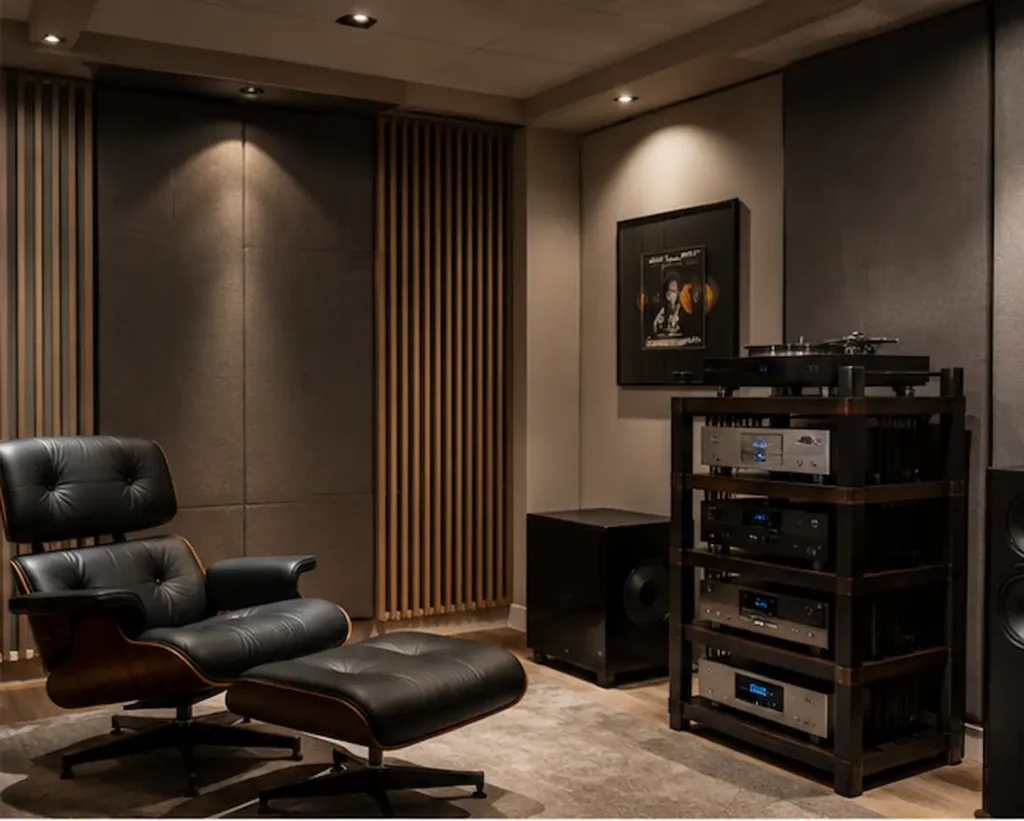
A dedicated listening room is not created by placing expensive speakers in an empty room and turning up the volume. The best rooms feel carefully resolved before the first song begins. The speakers disappear into the soundstage. Vocals feel centered without being pinned to one box. Bass has weight without overwhelming the room. Small details remain clear, even at comfortable listening levels.
That experience depends on much more than equipment.
Room dimensions, speaker placement, seating position, reflective surfaces, power planning, cable pathways, ventilation, lighting, and control all influence how the system performs. A great amplifier cannot correct every problem created by poor placement. Premium speakers cannot fully overcome a room that reflects too much sound or traps bass in the wrong places.
At Homeva, a listening room is treated as a complete residential system. The goal is not to make the technology more visible. It is to create a room where music feels natural, equipment remains easy to use, and every technical decision supports the experience rather than interrupting it.
A Listening Room Begins With the Room Itself
Homeowners often start with equipment because that is the most exciting part of the process. Speakers, amplifiers, turntables, streamers, and digital sources are easy to compare. Rooms are harder.
The room, however, becomes one of the largest components in the system.
Its width, length, and ceiling height influence how low frequencies build and move. Hard walls, large windows, concrete floors, and minimal furnishings can produce strong reflections. Deep shelving, upholstered seating, rugs, curtains, and carefully placed acoustic treatments can help control energy without making the room feel like a studio.
The strongest listening room setup begins with an honest look at the space.
Is the room symmetrical enough to support balanced speaker placement? Can the main seat be positioned away from the exact center of the room? Are there doors, windows, cabinetry, or circulation paths that limit where speakers can go? Will the equipment remain visible, or should it be integrated into millwork or a separate rack?
These questions should be answered before the system is purchased. Otherwise, the room may be forced to accommodate equipment that was chosen without understanding where it needed to live.
A dedicated space does not need to be enormous. It needs to be planned around proportion, placement, and the way the homeowner actually listens.
Listening Room Speaker Placement Shapes Everything
Speaker placement is one of the most important parts of a listening room, yet it is often treated as a final adjustment.
A pair of speakers can sound dramatically different depending on how far they sit from the front wall, how much space they have from the side walls, and how they are angled toward the listening position. Moving a speaker by a relatively small distance can change bass response, image focus, and the perceived width of the soundstage.
The listening seat matters just as much.
If the chair or sofa sits too close to the rear wall, bass may feel heavier and less controlled. If the seat sits in the exact center of the room, certain frequencies may cancel or build unevenly. If the speakers are positioned too close together, the soundstage can feel narrow. If they are too far apart, the center image may weaken.
A good starting point is symmetry, but real rooms often require adjustment.
One wall may open into a hallway. One side may include glass while the other includes cabinetry. A fireplace, doorway, or built-in feature may change how the room reflects sound. The final placement needs to respond to these conditions rather than follow a formula blindly.
Homeva approaches speaker placement as a balance between acoustic performance and the room’s architecture. The speakers should have the space they need, but the room should still feel composed and comfortable.
The Listening Position Is Not an Afterthought
Many homeowners focus on where the speakers will stand and assume the seating can be arranged later. In a high-fidelity room, the primary listening position deserves equal attention.
The seat controls the relationship between the listener, the speakers, and the room boundaries. It also affects sightlines, circulation, furniture scale, and how the room feels when it is not being used for focused listening.
A dedicated listening chair may offer precise placement, but not every homeowner wants a room that feels designed for one person. A wider sofa may support shared listening, though only the center position will usually receive the most precise stereo image.
There is no universally correct answer.
The better question is how the room will be used. Will the homeowner sit alone for focused album listening? Will the space be shared with a partner or family? Should the room also support reading, conversation, or quiet evening use? Will the system be used every day or primarily on weekends?
A listening room should support the ritual of listening without becoming too rigid to enjoy.
That is why seating decisions should be made alongside speaker placement, not after it.
Choosing Equipment for the Listening Room
Equipment should be selected as a system rather than as a collection of impressive individual components.
Speakers need amplification that can drive them comfortably. The amplifier needs source components that match the homeowner’s listening habits. Analog listeners may prioritize a turntable, phono stage, and careful isolation. Digital listeners may care more about streaming, network reliability, digital conversion, and app control.
Some homeowners want a simple two-channel system with very little visible technology. Others enjoy the equipment as part of the experience and want the turntable, amplifier, and record collection displayed openly.
Both approaches can work.
The important part is consistency. A listening room does not become better because one component is dramatically more expensive than the rest. It becomes better when the speakers, amplification, source, room, and installation support one another.
A well-designed home audio system also considers daily usability. The homeowner should not need a complicated sequence of remotes or apps just to play music. Source selection, volume control, and scene behavior should feel immediate and predictable.
High fidelity loses some of its value when the system feels difficult to live with.
A Hi-Fi Listening Room Needs Acoustic Control, Not Acoustic Clutter
Acoustic treatment often creates concern because homeowners imagine thick foam covering every wall. That may make sense in certain technical spaces, but it is rarely the right aesthetic for a refined home.
A hi-fi listening room needs acoustic control, but that control can be integrated thoughtfully.
Rugs help manage floor reflections. Upholstered furniture contributes to absorption. Curtains or motorized drapery can soften large areas of glass. Bookshelves and irregular surfaces can provide diffusion. Purpose-built panels can be wrapped in fabric that complements the room. Treatments may also be integrated into millwork, wall details, or decorative elements.
The objective is not to remove all reflection. A completely dead room can feel unnatural and uncomfortable.
The goal is balance.
Early reflections should be controlled enough to preserve clarity and imaging. Bass energy should be managed so the room does not feel boomy or uneven. The room should still retain enough life for music to feel open and engaging.
This is where measurement and listening should work together. Technical data can reveal problems the ear may struggle to locate, while listening confirms whether the final result feels musical rather than merely corrected.

Bass Is Usually the Hardest Part to Control
Bass behaves differently from higher frequencies because it interacts strongly with the dimensions of the room. Low frequencies can build in corners, weaken at certain seats, or feel uneven from one part of the room to another.
This is why simply adding a larger subwoofer does not always produce better bass.
Placement, phase, crossover settings, room dimensions, and the relationship between speakers and seating all influence the result. In some rooms, one carefully placed subwoofer can work well. In others, multiple subwoofers may create more even response across the room.
The objective is not maximum impact.
Good bass should feel integrated with the music. It should have weight, texture, and control without drawing attention to where it is coming from. A bass guitar should feel connected to the rest of the band. A kick drum should have definition, not only force.
A listening room that sounds impressive for five minutes can become tiring over a full album. Controlled bass is one of the details that allows the room to remain enjoyable for longer sessions.
Power Supply Planning Starts Before the Equipment Arrives
Power is often discussed only after the system is selected, but it deserves attention earlier.
A dedicated listening room may include amplifiers, source components, subwoofers, network equipment, control processors, record players, and lighting. These devices need safe, reliable power and outlets located where the equipment will actually live.
Poor outlet placement can lead to visible cords, crowded power strips, or cable paths that cross signal wiring unnecessarily. Insufficient planning can also make future upgrades more difficult.
The electrical strategy should consider circuit capacity, grounding, surge protection, outlet count, equipment location, and service access. It should also coordinate with the lighting plan so dimmers, transformers, and other electrical devices do not introduce avoidable noise into sensitive audio systems.
Clean power planning is not about adding dramatic accessories to the system. It is about building a stable foundation that supports reliable operation.
The best time to make these decisions is before walls, cabinetry, and equipment locations are finalized.
Cable Planning Protects Performance and Appearance
A listening room can sound exceptional and still feel unfinished when cables remain visible, crowded, or difficult to service. Speaker wire, interconnects, network cables, power cords, subwoofer connections, and control wiring all need a clear route through the space.
The goal is not simply to hide everything.
Cable planning should protect signal integrity while making future changes possible. Power and signal cables may need separate pathways to reduce unnecessary interference. Long speaker runs should be sized appropriately for the distance and system demands. Wall penetrations, floor outlets, cabinetry openings, and conduit should be positioned around the final equipment layout rather than added wherever access happens to be easiest.
Permanent construction should not trap temporary technology inside the wall.
A component may be replaced in a few years. A source may change. New speakers may require a different connection. Accessible conduit and serviceable pathways allow the listening room to evolve without opening finished walls or pulling apart custom millwork.
The cleanest system is not the one with the fewest visible cables on installation day. It is the one that remains orderly and adaptable over time.
A Listening Room Should Feel Quiet Before Music Starts
The quality of a listening room is often revealed in the moments before playback begins.
Air-conditioning noise, rattling vents, humming transformers, street sound, plumbing, and vibration from nearby rooms can all reduce the sense of clarity the system is meant to create. High-fidelity equipment may reproduce very quiet musical details, but those details are harder to appreciate when the room already has a noticeable noise floor.
This does not mean the room must become a professionally isolated recording studio.
It means the surrounding conditions deserve attention. Door seals, wall construction, duct placement, equipment ventilation, flooring assemblies, and adjacent mechanical systems can all influence the result. Even a quiet ceiling fan or noisy dimmer can become more noticeable during a soft passage of music.
The best listening rooms feel settled. They allow the system to move from near silence to full dynamics without the room adding its own distractions.

Invisible Sound Requires Visible Planning
Not every homeowner wants speakers and equipment to dominate the room.
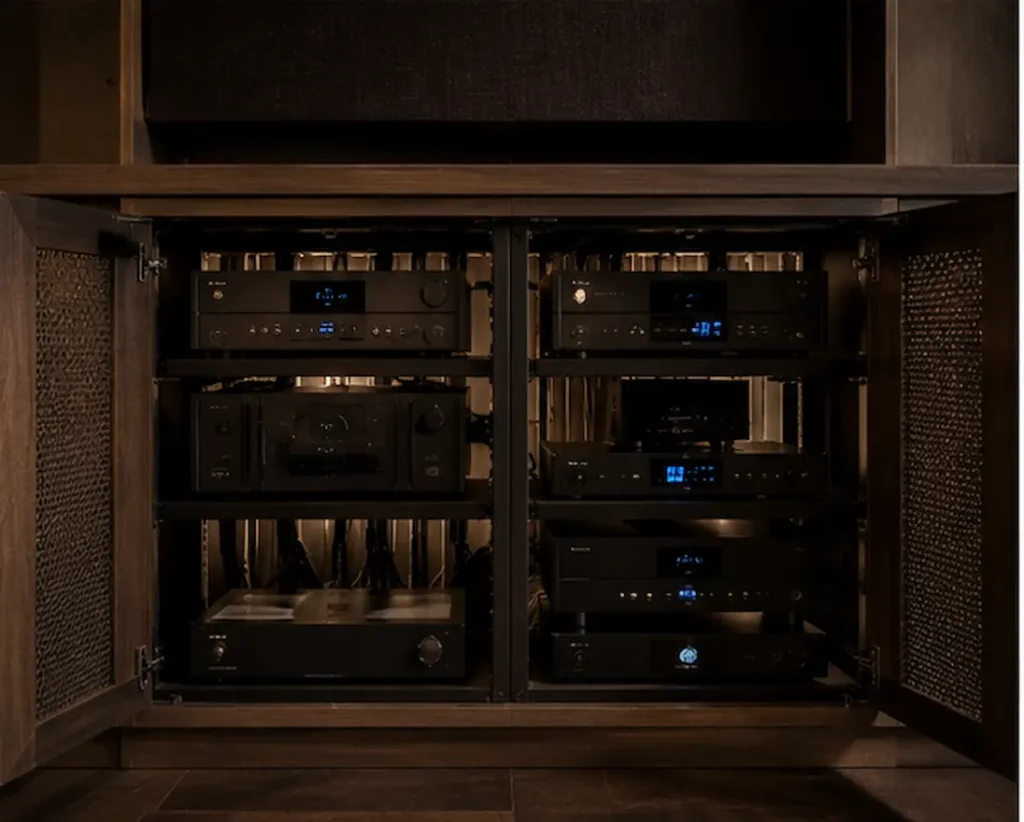
A dedicated listening system often celebrates visible components, but some spaces still benefit from a quieter architectural expression. Equipment can be integrated into cabinetry, cables can disappear into planned pathways, and acoustic treatments can become part of the wall design rather than separate technical objects.
The important distinction is that invisible sound should not mean compromised sound.
Concealing equipment requires more coordination because ventilation, access, speaker position, vibration control, and remote operation all need to be resolved behind the finished surfaces. A cabinet door should not block airflow. Millwork should not force speakers into poor positions. Concealed components should still be reachable when service is needed.
A listening room can feel elegant and residential without hiding every part of the system. Sometimes the speakers deserve to remain visible because their placement is central to performance. The rest of the installation can become quieter around them.
That balance often produces a room that feels intentional rather than equipment-heavy.
Connecting the Listening Room to Whole-Home Audio
A dedicated two-channel system and a multi-room audio system serve different listening experiences, but they do not have to operate as unrelated islands.
The listening room may be designed for focused, high-fidelity playback, while the rest of the home supports casual music in the kitchen, bedroom, patio, or entertaining areas. Thoughtful integration allows those experiences to coexist without forcing the dedicated system to behave like a general background-audio zone.
A homeowner may want to begin an album in the listening room, then continue related music elsewhere. They may want simple access to the same streaming services while preserving a higher-performance signal path in the dedicated space. They may also want volume and source control to feel consistent even though the equipment differs from room to room.
The challenge is maintaining simplicity without reducing the listening room to the limitations of the wider system.
Homeva can plan the room as part of the broader home audio environment while preserving the dedicated equipment, control, and acoustic decisions that make focused listening special.
How Homeva Plans a Dedicated Listening Room
Homeva approaches a listening room as a meeting point between architecture, acoustics, technology, and daily life.
The process considers room dimensions, speaker and seat placement, equipment compatibility, acoustic control, power supply, cable pathways, ventilation, lighting, network reliability, and control. Each choice affects the others. Moving the rack may change cable lengths. Changing the seating may affect bass response. Concealing equipment may require a different cooling strategy. Adding motorized shades may improve both glare control and acoustic behavior around large windows.
The system should never feel like a pile of premium products searching for a purpose.
It should feel like one complete room.
That means listening carefully to how the homeowner enjoys music. Some people want long, focused sessions with vinyl. Others want immediate access to high-resolution streaming. Some want the equipment displayed as part of the room’s character. Others prefer a quieter interior with technology placed out of sight.
Homeva’s role is to bring those preferences into a system that performs well, looks resolved, and remains straightforward to use.
Build the Room Around the Way You Listen
A listening room is ultimately personal.
The specifications matter, but they are not the reason the room exists. The room exists for the moment a familiar recording reveals something new, when the soundstage opens beyond the speakers, or when listening to an entire album feels more rewarding than skipping between tracks.
That experience comes from planning the whole environment rather than concentrating every decision on the equipment.
Speaker placement, seating, room treatment, power, cables, ventilation, lighting, and control all contribute to the final result. When those details are resolved together, the technology becomes less noticeable, and the music becomes more present.
If you are planning a dedicated listening room, refining an existing hi-fi system, or connecting high-fidelity audio with a larger whole-home sound experience, contact Homeva and design a listening room setup built around your space, your music, and the way you prefer to listen.
FAQ
What is the best size for a listening room?
There is no single ideal size. Room proportions, speaker scale, seating position, and acoustic behavior matter more than square footage alone.
Does a listening room need acoustic treatment?
Most rooms benefit from some treatment, but it can be integrated through rugs, drapery, furniture, millwork, and purpose-built panels.
Do audio systems need a dedicated power circuit?
Some systems benefit from dedicated electrical planning. The right approach depends on equipment demand, grounding, circuit capacity, and the existing home.
Where should speakers be placed in a listening room?
Placement depends on room dimensions, wall boundaries, speaker design, and seating. Final positioning should be tested and calibrated in the room.
Can a listening room connect to whole-home audio?
Yes. A dedicated high-fidelity system can connect with multi-room audio while preserving its own equipment, control, and listening quality.
How does Homeva design a listening room?
Homeva coordinates equipment, acoustics, placement, power, cabling, lighting, control, and whole-home integration around the homeowner’s listening habits.