
Motorized blackout shades Austin high-rise residents choose solve a problem unique to the category of space they live in. A unit on the 28th floor of The Independent, a west-facing bedroom in The Modern at 610 Davis, or a corner suite in one of the Rainey Street towers carries natural light that was an explicit selling point at purchase. Floor-to-ceiling glass, skyline views, and Austin light that changes character across a Texas day are part of what the investment was for.
The same glass that delivers those views also delivers radiant solar heat in the afternoons, streetlight and urban ambient glow through the night, and no visual privacy from neighboring towers at any hour. A blackout shade that deploys on a schedule or a voice command, without wrestling with a manual shade across ten feet of glass, is not a convenience add-on. It is a functional necessity dressed in the aesthetic vocabulary of the space.
Motorized blackout shades in this context are a finish-level decision with the same weight as flooring or cabinetry hardware, requiring the same specification rigor to perform correctly in a space where every material detail is visible from across the room.
At Homeva, downtown Austin high-rise installations present technical and aesthetic conditions that differ meaningfully from a residential house project. The cassette needs to fit within the window frame or ceiling pocket without interrupting the sight line of the glass. The fabric needs to achieve true blackout performance without the edge gap issues that affect consumer-grade installations in large-format window openings. The control integration needs to work within the smart home architecture the resident already has, or provide the entry point for one they want to build.
Why Standard Shades Fail Where Motorized Blackout Shades Austin High-Rises Demand
The window configurations in downtown Austin high-rise buildings are not what standard blackout shade products are engineered for. A floor-to-ceiling window in a high-rise unit may span eight to twelve feet wide and ten to fourteen feet tall, with a slim aluminum frame that provides almost no mounting surface and a glass line that starts within two inches of the finished ceiling. The physical scale of the opening, the absence of a traditional header, and the precision required to close the fabric edge gap without light leakage eliminate most consumer shade options before installation begins..
Motorized blackout shades Austin high-rise installations that perform correctly use side channels or cassette-integrated guide channels that hold the fabric edge in contact with the track throughout the shade’s full travel, eliminating the gap regardless of the opening’s width.
The cassette itself is easy to underestimate. A quality motorized blackout shade cassette houses the motor, stores the fabric when retracted, and presents a finished surface to the interior. In a unit with exposed concrete or high-gloss painted ceilings, a cassette that sits even slightly off-plane or carries visible seams reads as an installation error rather than a design element.
Slim-profile cassettes designed for recessed installation within a ceiling pocket, or for surface mounting against a concrete soffit with a tight reveal, are the specification-grade solution. The Lutron Sivoia QS shade system offers both cassette profiles sized for the large-format openings characteristic of Austin high-rise buildings.
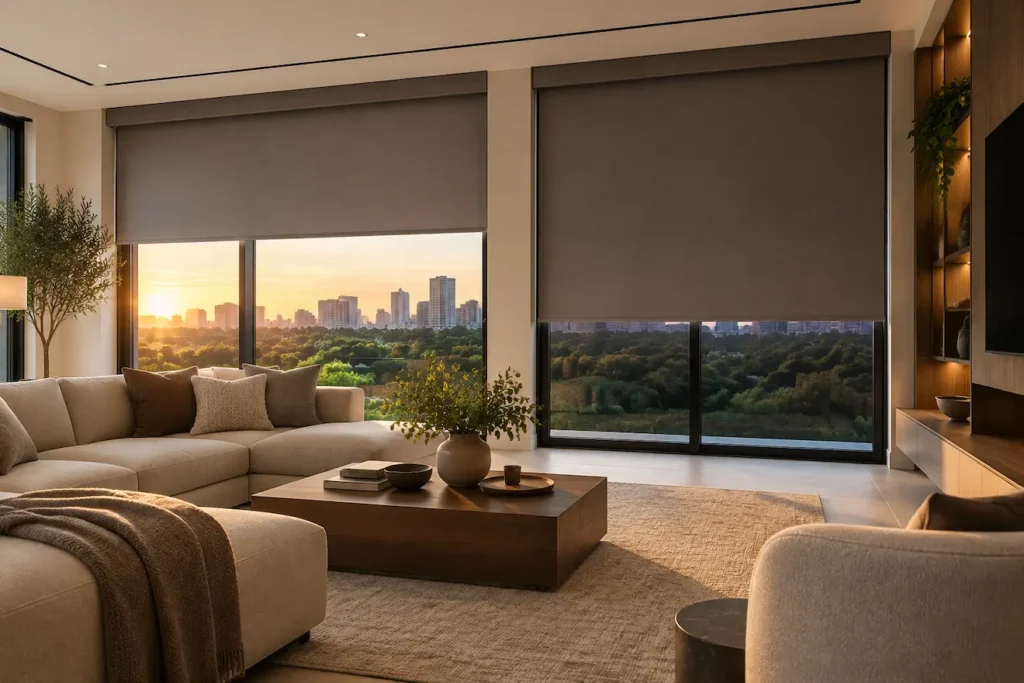
Solar Heat Gain and the Afternoon West Exposure Problem
The directional solar load is one of the defining challenges for motorized blackout shades Austin high-rise units face. Units with eastern exposure receive intense direct sun in early morning hours, with solar gain beginning before 7 a.m. in summer. Units with western exposure receive the most thermally significant load: direct afternoon sun from roughly 2 p.m. through sunset, during the hottest portion of a Texas summer day.
A west-facing unit in The Travis or in one of the towers along West 2nd Street without effective solar management is fighting its HVAC system for comfort during the hours when that fight is hardest to win.
Motorized blackout shades Austin high-rise installations serve a dual function: total light exclusion for sleep and media use, and a thermal barrier during peak solar hours. An insulating air gap between fabric and glass reduces effective heat transfer substantially compared to an unshaded window. In buildings with older glazing, the thermal benefit of deploying a blackout shade during peak afternoon hours is measurable in both comfort and HVAC load reduction.
The automation layer is where this thermal benefit becomes consistent rather than occasional. A motorized blackout shades Austin installation that closes the west-facing shades at 2 p.m. and reopens them at sunset on a schedule, regardless of whether the resident is home, maintains the thermal benefit every afternoon without behavioral change.
Installing Motorized Blackout Shades Austin Condos: HOA and Building Requirements
Motorized blackout shades Austin condo installations involve building-specific constraints that house installations do not. Most downtown Austin high-rise buildings require HOA or management approval for any modification affecting the window line, the electrical system, or the exterior-facing visual of the building. This exists because the building’s exterior appearance is a common element governed by the CC&Rs, and a cassette visible against the glass from the street affects the building’s aesthetic uniformity.
The question to confirm before specifying is whether the shade system, in its installed and retracted states, meets the building’s window treatment requirements. Most specification-grade systems with slim recessed cassettes satisfy this; consumer-grade systems with bulky housing often do not. Our motorized shades services evaluate the specific electrical conditions of each unit before specifying the connection type.
The building’s ceiling systems also constrain cassette placement. High-rise units typically have sprinkler heads, HVAC diffusers, and structural elements at intervals that limit where a cassette can be surface-mounted or recessed. Mapping these constraints before specifying the cassette location and electrical path prevents the field improvisation that produces a cassette mounted at an angle or a cable run exposed along the soffit. A professional installation begins with a detailed site visit, not a measurement and an order.
Motorized Blackout Shades Austin Integration with Smart Home Systems
The residents who invest in motorized blackout shades Austin at the specification level rarely do so in isolation. A downtown Austin professional who has furnished a unit at The Modern or 44 East Ave to a specific aesthetic standard typically has or is building a broader smart home architecture that includes lighting control, audio, and climate management. The shade specification needs to participate in that architecture rather than introduce a parallel control layer managed separately.
Lutron’s Sivoia QS shade platform integrates natively within the RadioRA 3 and HomeWorks QS environments, meaning a “Cinema” scene simultaneously lowers the shades, adjusts the lighting to a dim warm preset, and switches the audio, all from a single keypad press. For a resident with Lutron lighting already installed, adding motorized blackout shades to the same ecosystem requires no new control hardware.
For residents without existing smart home infrastructure, motorized blackout shades Austin are often the entry point for a broader integration project. The low-voltage wiring required for the shade motors, the control keypads, and the hub managing scene logic are the same components that would support lighting control and other automated systems in subsequent phases.
Specifying the shade infrastructure with future scalability in mind produces a wiring plan that accommodates the full system the resident might eventually want without reopening walls. In a condo where HOA approval is required for wall modifications, getting the conduit placement right the first time is a practical necessity.
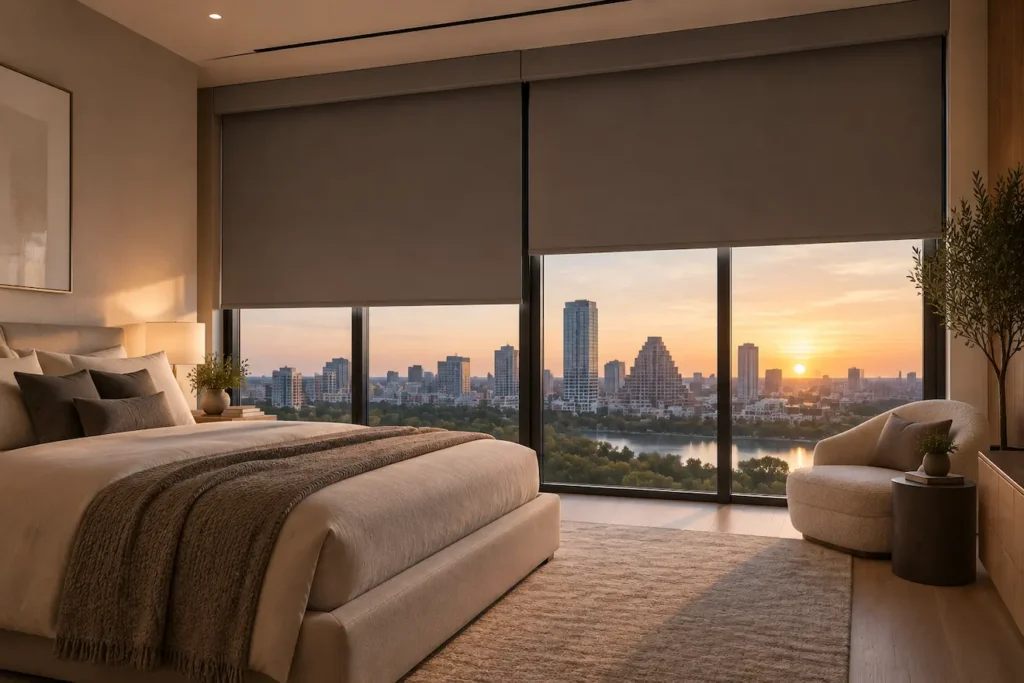
Fabric and Finish for Motorized Blackout Shades Austin High-Rise Installations
The fabric selection for motorized blackout shades Austin high-rise installations lives at the intersection of technical performance and interior design. True blackout performance requires a fabric with an opaque backing layer, typically a foam or acrylic coating bonded to the face fabric. In a room with high ceilings and a minimal finish palette, the face fabric’s texture and color carry significant visual weight. A linen-texture fabric in a warm white or natural tone reads as designed; a flat white synthetic reads as functional but not finished.
The acoustic dimension of fabric selection matters more in a high-rise than in a house. Urban ambient noise at elevation, traffic below, and HVAC equipment on neighboring rooftops combine to create a sound environment that a heavier shade fabric partially addresses.
A blackout fabric with a woven face and substantial backing provides measurable acoustic absorption compared to a lighter fabric, translating to a perceptibly quieter bedroom or home office with the shades deployed. This is a real secondary benefit in a context where the sonic environment is not as controllable as it is in a detached house.
The hardware finish of the cassette needs to coordinate with the dominant metal tone of the unit’s interior. Most downtown Austin high-rise units in the premium segment use brushed nickel or matte black as the primary hardware tone, and the shade cassette is visible when the shade is retracted.
A cassette in anodized aluminum, available in profiles that coordinate with both hardware tones, maintains the visual continuity that a white plastic housing disrupts in a space where every finish detail was considered. Contact Homeva to have support and make your home your favorite place.
FAQ
Do I need HOA approval to install motorized blackout shades Austin high-rises require?
It depends on the building and its CC&Rs. Most downtown Austin high-rise buildings require approval for modifications affecting the window line or exterior appearance. A specification-grade shade system with a slim cassette not visible from outside typically satisfies those requirements. Confirming with building management before ordering prevents problems.
What is the difference between blackout shades and room-darkening shades in a downtown Austin high-rise?
Blackout shades use an opaque backing layer producing zero light transmission through the fabric body. Room-darkening shades reduce light substantially but allow some through the weave or coating. In a downtown Austin high-rise bedroom where urban ambient light is present after midnight, room-darkening shades will not produce the total darkness that blackout shades achieve.
Can motorized blackout shades Austin condos use be hardwired in a completed unit?
Hardwiring motorized blackout shades Austin residents want is possible if ceiling access is available through an adjacent space or the unit above. If not, battery-powered Lutron Sivoia systems provide performance nearly equivalent to hardwired, with charging intervals of six to twelve months and no HOA approval required for electrical work.
How do motorized blackout shades Austin installations handle large window spans in high-rise units?
Large-format openings require a shade system specified for that span, with cassette and motor rated for the fabric weight and drop height. Side channels or cassette-integrated guide tracks hold the fabric edge in contact with the track throughout travel, preventing the light gaps that appear in standard installations at scale.
How do motorized blackout shades Austin residents use compare to manual alternatives?
A manual shade across a ten-foot opening requires meaningful physical effort to deploy and retract cleanly. A motorized shade travels to any programmed position silently and holds that position indefinitely. For a high-rise resident managing shades across several windows multiple times a day, the difference in daily friction is significant. The automation layer makes motorized blackout shades Austin residents rely on remove the decision entirely from routine use.