
Smart outdoor lighting in Austin Hill landscaping is not a decorative afterthought. It becomes part of the home’s architecture and daily rhythm. It is rarely just about visibility. It is about shaping how a property feels after sunset, when limestone textures soften, trees become silhouettes, and long Texas evenings shift the use of outdoor space.
At Homeva, automated home lighting is approached as a technical system first, and a visual layer second. The goal is not simply to place lights around a property but to design how light responds to movement, time, weather, and use.
The difference is subtle at first. It becomes obvious at night.
Why Smart Outdoor Lighting Austin Hill Country Homes Need Works Differently
Austin and the surrounding Hill Country present a very specific lighting environment. Homes sit at varied elevations, vegetation is dense but uneven, and properties often extend across large outdoor footprints.
That combination creates three challenges: First, light has to travel further without becoming harsh. Second, it has to blend with natural stone, wood, and landscape elements.
Third, it has to adapt to changing outdoor usage patterns.
A patio might function as a dining space at 7 pm, a quiet lounge at 9 pm, and a low-light background zone later at night. Static lighting struggles with that transition. Smart outdoor lighting in Austin Hill Country landscaping solves it through layered control and automated response.
This is where automation starts to matter more than brightness.
From Fixtures to Systems: The Shift Toward Automated Control
Traditional landscape lighting treats each fixture as an isolated point. A modern approach treats the entire exterior as one coordinated system.
This is where automated landscape lighting control systems become central.
Instead of manually switching zones on and off, lighting can respond to sunset and sunrise timing changes, seasonal daylight variation, motion near entry paths, predefined evening scenes, and security triggers during absence.
The goal is not complexity. The goal is consistency.
A well-designed system ensures that lighting behaves the same way every evening, regardless of who is home or how the day unfolded. That predictability is what creates comfort in outdoor environments.
In larger Hill Country properties, this also reduces the need for multiple manual controls across patios, gardens, driveways, and entry paths.
Designing Light as Part of the Landscape, Not on Top of It
The strongest outdoor lighting designs in Austin do not announce themselves. They feel integrated into the terrain.
Smart outdoor lighting in Austin Hill Country landscaping works best when it follows three visual principles:
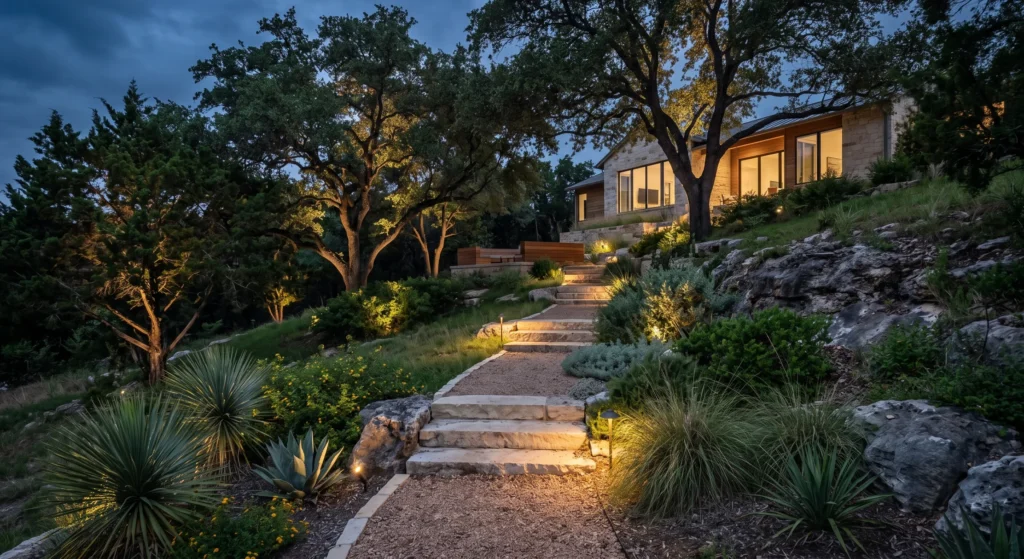
First, it respects elevation. Light should support natural slopes instead of flattening them visually. Second, it respects materials. Limestone, cedar, gravel, and native vegetation each reflect light differently. Third, it respects negative space. Not every area needs illumination. Darkness is part of composition. When lighting is designed this way, outdoor spaces feel intentional even when no one is actively using them.
This is where Homeva’s approach differs from standard installations. The focus is not fixture placement, but spatial behavior.
Energy Efficiency as a Design Constraint, Not a Feature
Energy efficiency is often treated as a technical upgrade. In smart outdoor lighting for Austin Hill Country landscaping, it should be treated as a design constraint from the beginning.
This changes decisions early in the process:
LED temperature is selected based on landscape tone, not just efficiency ratings. Zone grouping is designed to reduce unnecessary overlap. Dimming curves are calibrated for real usage hours, not maximum output.
With energy-efficient outdoor lighting design, the objective is not simply lower consumption. It is stable performance over time without visual fatigue or over-illumination.
In Texas properties where outdoor lighting can span long perimeters, efficiency also becomes a maintenance factor. Systems that run cooler, dim intelligently, and activate only when needed tend to last longer and require fewer adjustments.
Outdoor Lighting Automation Schedules and Daily Life
One of the most practical layers of outdoor lighting design is timing.
Outdoor lighting automation schedules define how a property transitions from day to night without manual input.
A typical structure might include: Soft activation at sunset for pathways and entry zones, full landscape illumination during active evening hours, reduced ambient lighting after midnight, security-focused baseline lighting overnight. But the real value is not the schedule itself. It is the ability to adapt to it.
In Hill Country homes, lifestyle patterns vary widely. Some properties host frequent outdoor gatherings. Others prioritize quiet evenings or travel periods. Automation allows lighting to shift without redesigning the system each time.
When combined with motion detection and scene presets, schedules stop being static timers and become behavioral frameworks.
Layering Light: How Smart Systems Shape Outdoor Atmosphere
A well-designed system does not rely on a single lighting type. It layers multiple effects: Path lighting for movement, uplighting for trees and vertical elements, accent lighting for architectural features, ambient wash for general visibility, security lighting for perimeter awareness, smart outdoor lighting Austin Hill Country landscaping becomes effective when these layers are coordinated instead of competing.
For example, accent lighting can remain subtle while ambient lighting adjusts based on occupancy. Path lighting can intensify only when motion is detected. Uplighting can remain fixed but dimmed during late hours.
The result is no brighter outdoor space. It is a more readable space.
Technical Control: Where Design Meets Infrastructure
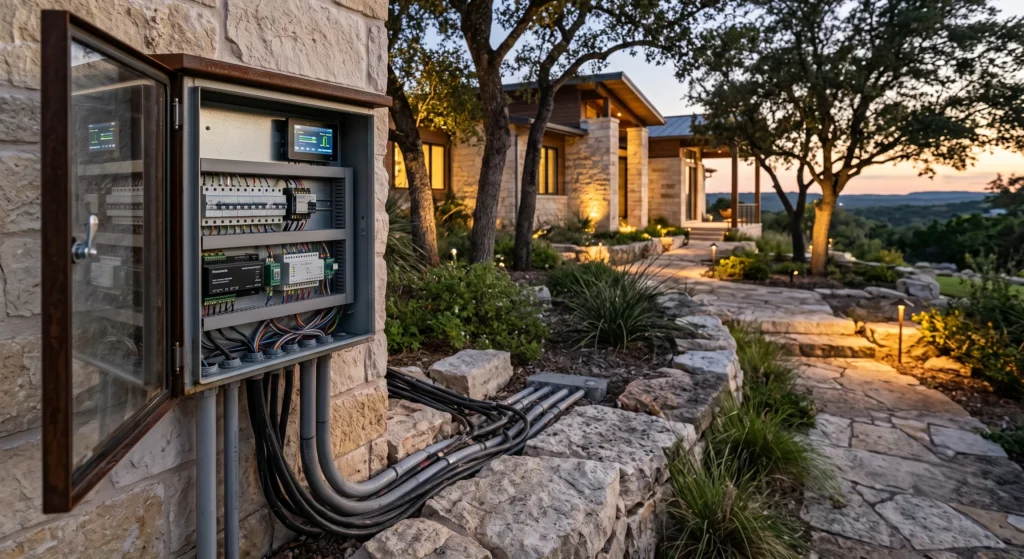
Behind every refined outdoor lighting system is a control layer that determines reliability.
This includes load balancing across circuits, weather-resistant control units, signal stability across large properties, integration with smart home ecosystems, and remote access for adjustments. This is where automated landscape lighting control systems matter most. Without a stable backbone, even the best design loses consistency over time.
Homeva’s approach prioritizes this infrastructure early, because outdoor systems in the Hill Country often span longer distances and more exposure than standard residential layouts.
Common Mistakes in Outdoor Lighting Design
Many outdoor lighting systems fail for reasons that have little to do with fixture quality.
The most common issues include: Over-lighting key areas until the space feels flat, ignoring transition zones between indoor and outdoor spaces, placing fixtures without considering viewing angles from inside the home, using uniform brightness instead of layered intensity, and skipping automation in favor of manual control.
These mistakes usually appear after installation, when the system feels harder to use than expected. Smart outdoor lighting in Austin Hill Country landscaping avoids this by designing behavior first, not hardware.
How Homeva Approaches Outdoor Lighting in the Hill Country
At Homeva, outdoor lighting is treated as part of the home’s larger automation structure. It connects with indoor lighting, shading, and control systems so that the property behaves as one environment.
That means lighting decisions are not isolated. They are coordinated with how the home is used throughout the day.
In practical terms, this includes: Defining how spaces transition from daylight to evening use
Aligning outdoor scenes with indoor lighting moods, ensuring energy efficient outdoor lighting design is consistent across zones, creating automation logic that reflects real routines instead of generic presets.
The goal is not a complex system. It is a predictable one that feels natural to live with.
When Outdoor Lighting Feels Invisible, It Is Working Correctly
The strongest outdoor lighting systems in Austin do not call attention to themselves. They support movement, safety, and atmosphere without dominating the landscape.
Smart outdoor lighting in Austin Hill Country landscaping achieves that balance when three things align: Technical control is stable, energy use is intentional, and automation matches real life. When those layers work together, outdoor spaces stop feeling like separate zones. They feel like an extension of the home.
Designing Lighting That Matches the Way You Live Outdoors
Every property in the Hill Country has a different rhythm. Some are built for gatherings, others for quiet evenings, and many shift between both depending on the season.
The right lighting system reflects that rhythm instead of forcing a fixed pattern.
If you are considering smart outdoor lighting in Austin Hill Country landscaping for your property, the next step is not choosing fixtures. It is understanding how your space should behave after sunset.
That is where Homeva focuses its work, connecting design, automation, and technical control into a single system that feels intentional from the first night it is used.
To plan a system that fits your property and your lifestyle, you can connect with Homeva and design an outdoor lighting setup that is built around how your home actually lives at night.
FAQ
What makes smart outdoor lighting different from standard lighting?
It uses automation and control systems to adjust brightness, timing, and zones based on usage and conditions.
Is automated outdoor lighting worth it in residential homes?
Yes, especially in larger properties where lighting zones and schedules benefit from consistency and control.
Can outdoor lighting automation reduce energy use?
Yes, systems can dim, schedule, and activate only when needed, reducing unnecessary consumption.
Does smart outdoor lighting work with other home systems?
It can integrate with lighting, shading, and broader smart home controls depending on system design.
How important is design in outdoor lighting systems?
Very important. Design determines how light interacts with space, materials, and movement, not just visibility.