
Mueller and East Austin have produced some of the most design-forward residential architecture in Central Texas over the past decade. Open floor plans, polished concrete, exposed structural elements, and oversized windows are the norm here, not the exception, and that aesthetic context makes TV wall mounting in Austin a more consequential decision than it would be in a conventional suburban build.
A poorly placed or sloppily installed screen works against everything a well-designed modern home is trying to achieve visually, and in these neighborhoods, that tension is immediately apparent.
The specific construction vocabulary of Mueller and East Austin homes creates technical considerations that generic mounting solutions are not built for. Concrete accent walls, steel-stud framing, open-concept volumes without obvious focal walls, and tight townhome footprints all require a different approach to hardware selection, cable management, and placement logic than a standard wood-framed interior. Getting each variable right is what separates a TV wall mounting result that looks integrated from one that looks like an afterthought.
At Homeva, we navigate these decisions on every project, whether we are mounting a single screen in a Mueller townhome or planning a whole-home installation across a fully renovated East Austin bungalow. Our TV installation services are built around the architectural realities of Austin’s modern homes rather than a generic process that ignores them.
Why TV Wall Mounting in Austin’s Modern Homes Requires a Different Approach
The homes that define Mueller and East Austin share a characteristic that complicates television placement: they are designed to minimize visual clutter. Clean wall planes, intentional material choices, and the deliberate absence of unnecessary hardware are not accidental in these spaces. A television mounted at the wrong height, on the wrong wall, or with cables trailing to a visible outlet reads as a contradiction of the room rather than a part of it, and in a home where the design has been considered carefully, that contrast is hard to ignore.
Placement decisions require working through the full viewing geometry before drilling a single hole. The screen center should align with seated eye level, typically 42 to 48 inches from the finished floor for a standard sofa. Horizontal position has to account for the primary seating axis and any secondary viewing positions created by kitchen islands or dining areas that share sightlines in open-concept plans.
Exposed brick, which appears in both renovated bungalows and newer infill builds drawing on the industrial aesthetic of the East Austin corridor, requires masonry anchors and specific drilling technique rather than the wood screws that work in standard drywall.
Concrete feature walls demand a hammer drill, the correct masonry bit, and properly rated anchors. Getting the hardware right for the specific substrate is not optional; a TV wall mounting in Austin that pulls free from an improperly anchored masonry surface is a structural failure, not just a cosmetic one.
Choosing the Right Mount: Fixed, Tilt, and Full-Motion
The mount type determines most of the daily experience of using the screen, and it is one of the decisions most frequently made on aesthetic grounds rather than functional ones. Fixed mounts hold the screen flush against the wall and produce the cleanest silhouette, which makes them appealing in design-forward spaces.
They are the right choice when the primary seating is centered directly in front of the screen, the mounting height can be set precisely for that geometry, and no secondary viewing position requires a different angle. A properly executed TV wall mounting in Austin with a fixed mount on a flat painted surface is the most architecturally integrated result available.
Tilt mounts add downward angle adjustment, typically five to fifteen degrees, which matters most when the available wall surface requires a higher mounting position than ergonomics prefer. This is a common situation in Mueller townhomes and East Austin homes with tall ceilings where the only unobstructed wall space sits above a credenza or media console.
In an open-concept plan where kitchen, dining, and living share one volume, a full-motion TV wall mounting Austin can bring the screen within a comfortable viewing angle from anywhere in the space. The functional trade-off is that full-motion hardware has more visual presence when the arm is extended, which is a genuine consideration in rooms where the mount profile is part of the overall composition.
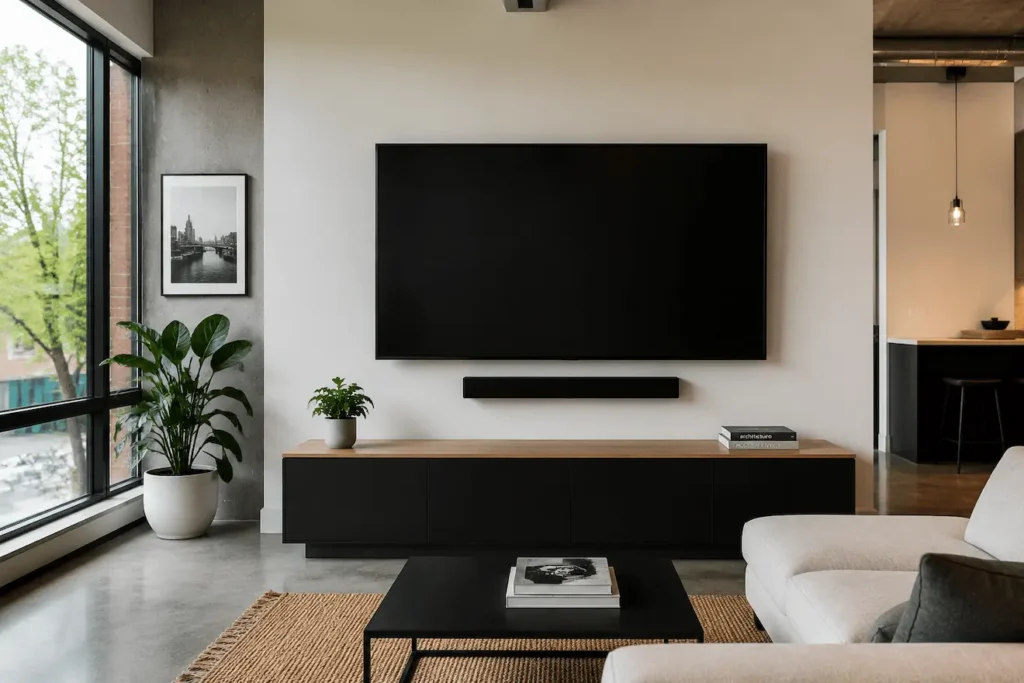
Cable Management: Where TV Wall Mounting in Austin Succeeds or Fails
Cable management is where the majority of professional TV wall mounting work in Austin either succeeds or fails from a design perspective. The mount itself is largely invisible once the screen is placed; the cables are not. A television mounted cleanly on an East Austin feature wall with an HDMI cable and power cord visible against the surface undermines every other decision in the room’s finish. Getting cable management right requires planning that begins before the mount goes up, not after.
For Mueller and East Austin homes currently under renovation, this is the moment to specify the electrical rough-in correctly: a recessed outlet at the mount location and a low-voltage cable plate at the equipment position below, connected by conduit inside the wall cavity. Getting this in before drywall closes costs a fraction of what it takes to add afterward.
In completed homes where opening the wall is not practical, paintable surface-mounted raceway systems are the professional alternative. High-quality channels matched closely to wall color read as part of the finish rather than a hardware addition, particularly on flat painted surfaces.
On exposed brick or concrete, selecting a raceway profile that works with the material’s texture and securing it with masonry-rated adhesive or fasteners produces a result that is categorically different from an unmanaged cable drop, even if it will never be as invisible as an in-wall solution.
The Fireplace Wall: Austin’s Most Requested TV Location
The fireplace wall is the most requested TV wall mounting location in Austin homes, and it produces more ergonomic and technical problems than any other configuration. The appeal is understandable: concentrating two visual focal points on one wall frees the remaining surfaces for other purposes. The problem is the height a fireplace mantel imposes.
With the screen center well above the 42-to-48-inch ergonomic range, extended viewing requires looking upward at an angle that puts sustained load on the cervical spine, a discomfort that builds across a two-hour film in ways that shorter viewing sessions do not reveal.
The architectural surface of most Austin fireplace walls adds technical complexity. Stone, brick, and cast concrete surrounds all require masonry hardware and different anchoring techniques than a drywall field. Drilling into mortar joints rather than the brick face is a common error that results in a significantly weaker anchor than the brick itself would provide.
Heat transfer is also a real consideration: a wood-burning or gas fireplace moves heat up the wall face, and the electronics inside a television have manufacturer-defined operating temperature limits that should be checked against the actual wall temperature during normal use before committing to a fireplace wall mounting.
The practical solution for homeowners committed to this location is a pull-down mantel mount, which stores the screen above the mantel and lowers it to near-eye-level during viewing. This approach combines the visual tidiness of a high placement when the screen is off with a functional ergonomic position when it is on.
Open-Concept Rooms: TV Wall Mounting and the Sightline Problem
Mueller and East Austin’s most common floor plan, the open-concept great room where kitchen, dining, and living share a continuous volume, creates a sightline geometry that a single fixed mount position cannot serve equally well. In a conventional closed living room the viewing axis is defined by the sofa and the wall it faces.
In an open plan there are often three or four meaningful positions at different angles and distances, and a fixed mount optimized for the sofa will be incorrect for the kitchen island and off-axis for the dining table. Full-motion mounts address the problem mechanically, allowing the screen to pivot toward the active position.
A well-specified TV wall mounting Austin, in a Mueller kitchen-living area can swing far enough to serve both the sofa and the island without requiring viewers at either location to negotiate a bad angle. In rooms with a high design standard, mount profile and finish should be selected to coordinate with the room’s other hardware rather than defaulting to whatever the big-box store offers in the category.
Placement also requires accounting for natural light before the mount position is committed. Large south-facing windows in a Mueller home produce afternoon light that creates screen reflections no mount adjustment can correct after the fact. The wall or position that avoids cross-lighting from the primary windows should be identified in the planning phase, even when it means a less symmetrical or less visually obvious location than the first instinct suggests.
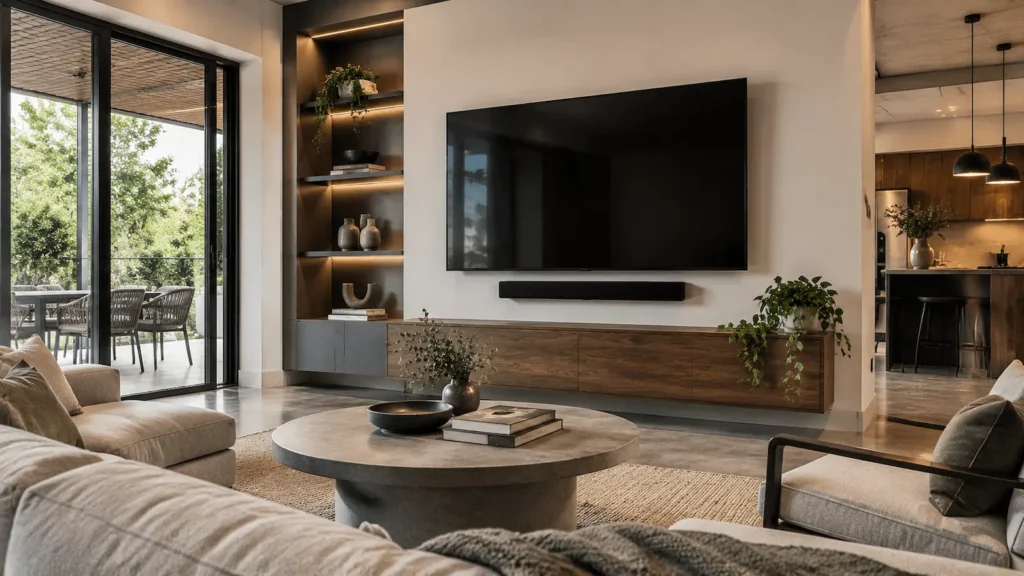
Multi-Room Planning and Low-Voltage Coordination
Many Mueller homeowners arrive at TV wall mounting in Austin city as part of a broader renovation touching multiple rooms, and the decision made in one room has direct implications for every other. A home with three or four screens sharing a distributed AV system requires low-voltage infrastructure between equipment locations: HDMI home runs, network drops for IP-based video, or coaxial distribution for cable and antenna signals.
Professional TV wall mounting in Austin, when it is part of a larger renovation, belongs in the planning conversation alongside the electrical rough-in. The location of the recessed outlet behind the screen, the conduit path to the equipment position, and the location of the media closet or rack that houses source components all need to be resolved together.
A mount location chosen without knowing where the conduit will run often creates a cable path that is either visible or requires reopening finished wall surface to correct. For homeowners whose renovation timing makes early coordination possible, investing in that conversation before framing closes produces a result that no after-the-fact patch can replicate.
The professional approach is a thoughtfully managed surface installation that minimizes visible cable runs through careful routing and quality raceway hardware. Either way, the conversation starts with a site visit that evaluates the specific wall materials, room geometry, and equipment inventory before any hardware is ordered. If you are ready to begin that process, connect with Homeva and we will walk through your home with the attention it deserves.
FAQ
What makes TV wall mounting in Austin’s modern homes different from a standard install?
The construction materials common in Mueller and East Austin, including exposed brick, concrete accent walls, steel studs, and open-concept volumes, require different hardware and placement logic than standard drywall-over-wood-stud construction. Visible cable management is also a more critical design concern in these design-forward spaces.
How high should a TV be wall-mounted?
The screen center should align with seated eye level, typically 42 to 48 inches from the finished floor for a standard sofa height. Mounting above this range creates a viewing angle that produces neck strain during extended use and should be addressed with a tilt or pull-down mount rather than accepted as a fixed condition.
Can a TV be safely mounted on concrete or exposed brick?
Yes, with the correct hardware. Concrete requires a hammer drill, masonry bits, and Tapcon screws or sleeve anchors rated for the combined weight of the TV and mount. On brick walls, anchors should go into the brick face rather than the mortar joints, which are softer and less reliable over time under load.
Is it safe to mount a TV above a fireplace?
It is possible with the right planning, but it introduces an ergonomic problem from the elevated viewing angle and a heat exposure concern for the television’s electronics. A pull-down mantel mount addresses the height issue. The heat concern requires verifying that the wall temperature at the mount location during normal fireplace use falls within the TV manufacturer’s operating temperature range.
What is the cleanest cable management solution for a modern home?
In-wall routing with a recessed outlet behind the screen, specified during renovation before drywall is applied, is the cleanest result. In completed spaces, high-quality paintable raceway systems matched to the wall color are the professional alternative. Unmanaged cables hanging from a mounted TV are not an acceptable finish in a design-forward home.
When should a professional handle TV wall mounting instead of a DIY approach?
Masonry walls, screens 65 inches and larger, above-fireplace installations requiring precise tilt calibration, and any project involving in-wall cable routing or new electrical work all warrant professional installation. The risks of an improperly anchored masonry installation or a code-non-compliant electrical modification outweigh the cost savings of handling it without the right tools and experience.