
Human centric lighting design starts from a premise most residential lighting ignores: the light in your home is not a neutral utility. It is biological information. The spectrum, intensity, and timing of the light your eyes receive throughout the day directly influences melatonin production, the regulation of your sleep-wake cycle, and the quality of your attention during the hours when you need it most. A home lit at 4,000K and 800 lux from seven in the morning until eleven at night delivers a physiological signal that has nothing to do with what your body needs.
A home designed with human centric lighting principles delivers something different: light that adapts its spectrum and intensity continuously as the day progresses. The scientific foundation was established in the early 2000s with the discovery of a third class of photoreceptors in the human retina, the intrinsically photosensitive retinal ganglion cells, or ipRGCs. Unlike the rods and cones responsible for visual perception, ipRGCs contain a photopigment called melanopsin with peak sensitivity to blue wavelengths around 480 nanometers, and their primary function is regulating the circadian system rather than forming images.
At Homeva, human centric lighting design is not a product category we offer alongside our other services. It is the framework through which we think about every interior lighting installation, because the difference between a lighting system that performs technically and one that actually serves the people living in it is precisely this biological dimension.
The specification choices that matter most in a luxury residential project, the color temperature range of the source, its CRI across that range, the control architecture that manages daily transitions, are all HCL questions whether or not they are framed that way from the beginning.
The Science Behind Human Centric Lighting Design and What It Tells Your Body
The circadian system operates on an approximately 24-hour rhythm synchronized primarily by light. Dawn light is blue-enriched and high-intensity, signaling wakefulness and suppressing melatonin; evening light shifts toward warm amber as the sun descends, triggering the hormonal cascade that prepares the body for sleep.
Indoor environments break this rhythm in two ways: they replace dawn light with static sources that are neither bright nor spectrally appropriate for robust morning alertness, and they maintain the same conditions into the evening, suppressing melatonin at exactly the point when its production matters most.
Equivalent Melanopic Lux, or EML, quantifies a light source’s biological effect independently of its photopic brightness. A spectrally blue-enriched light produces high EML even at modest visual intensity; warm amber light at the same photopic brightness produces far less melanopic stimulation.
The WELL Building Standard requires a minimum of 250 EML at the primary viewing angle for occupied daytime spaces, and specifies that sleeping areas should not exceed 50 EML during evening hours. These thresholds are derived from dose-response research on melatonin suppression and circadian phase shifting that underlies the entire field of human centric lighting design.
The practical consequence for interior design is that a room serving multiple functions needs different lighting conditions at different hours, managed actively rather than accepted as whatever the fixture produces at a given dimming level. A breakfast table serving morning alertness needs different lighting than the same table used for a long dinner.
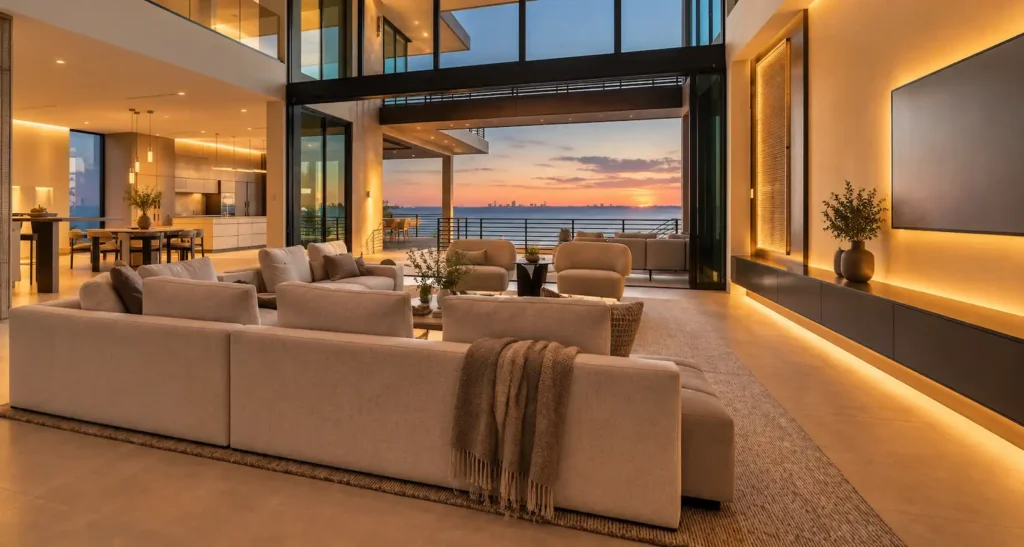
Tunable White Technology: The Hardware Foundation of Human Centric Lighting Design
Standard LED sources produce white light at a single fixed color temperature. A 2,700K fixture is 2,700K at full output and at five percent output; dimming changes intensity but not spectrum. Tunable white technology decouples those two variables by using LED arrays with multiple channels of different spectral composition, mixed in varying ratios to produce white light across a range of color temperatures from a single fixture.
This is the hardware capability that makes human centric lighting design achievable in a residential context, allowing one installed fixture to serve the full biological requirement of a room across its daily arc without any physical change.
This means the warm amber at 2,200K in the evening has the same color accuracy as the cool 6,500K output in the morning, which matters for a room where the visual quality of food, skin tones, artwork, and fabric needs to remain accurate at every hour.
The alternative to purpose-built tunable white systems is a two-channel approach using separate warm and cool LED arrays blending across a range of roughly 2,700K to 6,500K. These systems are less expensive and produce acceptable HCL results for many residential applications. The limitation is color consistency at intermediate temperatures: two-channel blending may shift slightly in hue or green-pink balance, which is visually subtle but meaningful in interiors where the rendering of finished surfaces is part of the design intent.
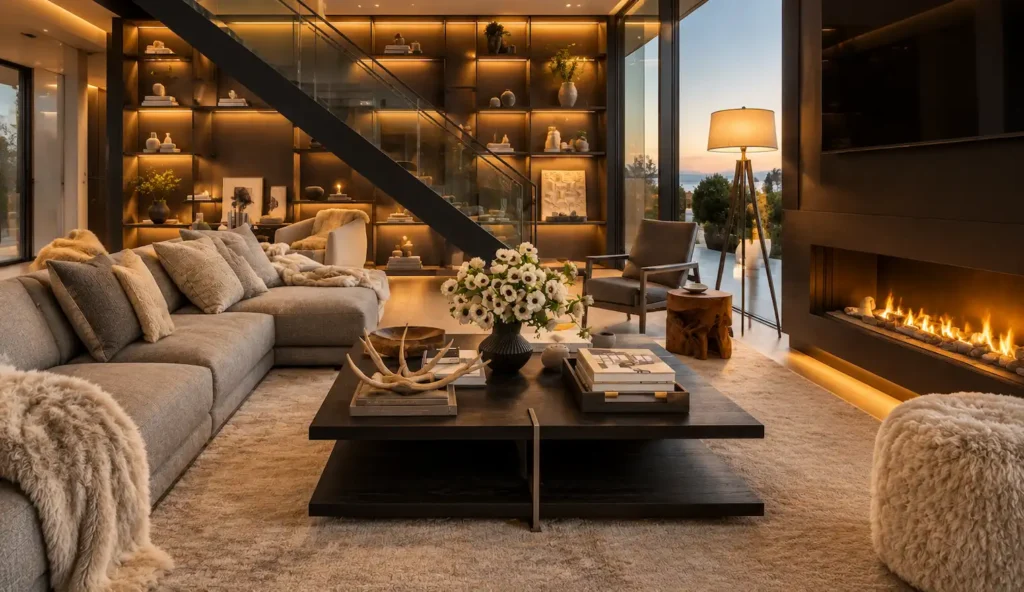
Designing the Daily Light Arc for a Residential Interior
A well-designed human centric lighting profile follows the logic of daylight, adapted to the household’s specific rooms, activities, and schedules. Morning light in primary living areas runs between 4,000K and 5,500K at intensities associated with robust circadian entrainment. Midday holds near neutral, typically 3,500K to 4,000K. The late afternoon transition shifts toward warmth, reaching 2,700K to 3,000K by early evening, coordinated with the motorized shade position so the transition is perceptually smooth.
This arc does not require the household to manage anything. The control system programs transitions as a continuous function rather than a series of fixed scenes, so the light moves imperceptibly from one state to the next. The occupant who sits at the breakfast table at seven and is still there at eight experiences the room shifting around them without any perceptible moment of change.
This is the version of human centric lighting design that delivers genuine residential value: not a feature the homeowner manages, but an environmental condition they live in that serves them without requiring attention.
Room-by-room differentiation is the layer that separates a thoughtful human centric lighting design specification from a whole-home color temperature schedule. The primary bedroom has different requirements than the home office, which differs from the kitchen, which differs again from the media room.
Our home lighting design services approach each room as a distinct program within the larger daily arc, with transitions timed to the room’s function and the household’s actual schedule rather than to a generic residential template.
Human Centric Lighting Design: Fixture Selection and Architectural Integration
Human centric lighting design depends on fixture selection and placement more critically than standard residential lighting, because the spectral requirements of HCL narrow the field of appropriate sources more sharply than visual comfort alone. A fixture that performs beautifully at 2,700K and cannot maintain color consistency at 4,500K is not an HCL fixture regardless of its other credentials.
For Homeva, the architectural integration means getting the aperture profile, trim depth, and optic geometry right before anything else is determined. Ketra recessed downlights, tunable linear systems for coves and architectural reveals, and tunable pendant sources need to be specified as part of the architectural drawing package rather than selected at the end of the construction process when ceiling conditions are already fixed.
Human Centric Lighting Design by Room: Where the Benefit Is Greatest
The primary bedroom delivers the most measurable return on a human centric lighting design investment for most families. Sleep quality is the outcome most directly linked to circadian regulation, and the bedroom is where the evening light transition has the greatest physiological impact. A bedroom system that dims to 2,200K at 10 to 15 percent output two hours before bedtime, and eliminates all blue content in the hour before sleep, creates measurably better conditions for melatonin onset than a bedroom dimmed from a fixed 3,000K source.
The home office is where human centric lighting design produces its most immediate alertness benefit. A workspace that holds 5,000K at 500 lux or above during morning deep work hours and transitions to 3,500K in the afternoon as tasks shift to communication and review aligns the spectral environment with the activity without requiring the occupant to notice or manage the change.
The kitchen serves more varied purposes than almost any other room, and the HCL specification reflects that range. Morning preparation needs high-EML alerting light. Afternoon cooking benefits from high-CRI neutral white that renders ingredients accurately.
An evening dinner warrants warm amber at an intensity that creates the visual enclosure and social warmth the meal deserves. A tunable white system producing all three from the same fixtures delivers a kitchen environment that static lighting cannot match across a full day. At Homeva, we can help you to make the best decision for your house, contact us now for receiving all the details.
FAQ
What is human centric lighting design and how is it different from standard residential lighting?
Human centric lighting design specifies the spectrum, intensity, and timing of artificial light to align with the body’s natural circadian requirements. Standard residential lighting provides a fixed color temperature and relies on dimming alone for adjustment. HCL uses tunable white sources to shift color temperature continuously across the day, matching the biological signals natural daylight provides.
What is Equivalent Melanopic Lux and why does it matter?
Equivalent Melanopic Lux, or EML, quantifies a light source’s biological effect on the circadian system independently of its photopic brightness. The WELL Building Standard recommends a minimum of 250 EML for occupied daytime spaces and specifies that sleeping areas should not exceed 50 EML during evening hours. Standard lux measurements do not capture this biological dimension.
Which systems support human centric lighting in luxury residential projects?
Lutron’s Ketra platform is the specification-grade standard for luxury residential HCL. Its four-channel LED engine produces white light from 1,400K to 10,000K with CRI and R9 above 90 throughout the full range, with Color Lock technology maintaining color consistency across the system’s lifetime. Ketra fixtures integrate natively within Lutron’s HomeWorks QS and RadioRA 3 control environments.
Does human centric lighting design require a full lighting renovation?
Not necessarily. HCL can be implemented in phases, beginning with the rooms where the benefit is greatest: the primary bedroom and the home office. In new construction, specifying tunable white fixtures from the design phase is most cost-effective. In existing homes, Ketra and similar systems can often replace conventional dimmers with a wiring assessment.
How does an HCL system know what time it is and what the light should be?
The control processor manages daily transitions through a programmed schedule configured around the household’s routines and biological targets. Transitions run as continuous functions rather than fixed scene steps, so the shift in color temperature across the day is imperceptible. The system integrates with motorized shades to maintain target EML levels regardless of weather or season.
Is the biological benefit of HCL scientifically established?
Yes. The discovery of ipRGCs and their role in circadian regulation is well established in peer-reviewed research, and the relationship between short-wavelength light exposure and melatonin suppression is one of the most consistently replicated findings in photobiology. The EML targets and color temperature transitions draw from this research base and from standards like the WELL Building Standard.