
Smart gallery lighting Austin collectors choose for their homes does something standard residential lighting never manages: it lets the art be the room. Austin’s visual art scene has enough depth that a home collection drawn from it carries real identity. A painting from grayDUCK Gallery on East Cesar Chavez, a sculptural piece found at Canopy Austin’s rotating studios, a large-format work from Wally Workman that took three visits to commit to: each represents a choice made with care, and each deserves a lighting specification that treats it with the same seriousness the collector brought to the acquisition. The lighting in most homes does not do that.
The difference between residential lighting that happens to include artwork and smart gallery lighting designed around it is a matter of specification discipline. Beam angle, color rendering index, the spectral quality of the source at the wall surface, the distance and angle of the fixture from the work, and the control architecture that manages how the light behaves across different times of day: these are the variables that separate a collection that commands attention from one that disappears into the wall. Austin’s collectors, who have spent time in venues that get this right, bring a formed aesthetic expectation to the conversation.
At Homeva, homes with significant art collections are the ones where the lighting conversation starts earliest and goes deepest. A piece hanging in the wrong light is not a display failure; it is a specification failure that could have been resolved at the design phase, and every fixture decision in an art-facing room is made in relationship to the work.
CRI, R9, and the Spectral Science Behind Smart Gallery Lighting Austin Homes Require
The most consequential specification in smart gallery lighting is the color rendering index, and it is the one most frequently underspecified in residential projects. A CRI of 80, standard for builder-grade LED fixtures, does not tell you how the source handles saturated reds, warm earth tones, or the specific pigment palette of a piece you paid real money to own. Under a CRI 80 source, a painting by one of Austin’s contemporary figurative artists has its colors compressed, its transitions flattened, and its presence reduced to a quieter version of what the painter intended.
The R9 value is the specific metric that matters most for warm or saturated color content, and it is almost never listed in consumer product specifications. R9 measures how accurately a source renders deep saturated red, which appears in skin tones, warm neutrals, and layered paint surfaces, not only in explicitly red objects. For smart gallery lighting Austin installations where warm color is central to the artist’s vision, an R9 value above 50 is the minimum acceptable specification, with 80 or above preferred.
Ketra’s tunable white platform operates from 1,400K to 10,000K while maintaining CRI and R9 above 90 throughout that range. The implication for a collection with different spectral requirements, a warm-toned oil next to a cool-toned photograph, is that a single tunable white source can serve both under the same fixture. Specifying this level of color fidelity is one of the design decisions our home lighting design process resolves before a single fixture is ordered.
Beam Angle and Fixture Geometry for Smart Gallery Lighting Austin Works
The beam angle of the accent fixture determines whether light arrives at the artwork as a contained, intentional accent or as spillover that illuminates the surrounding wall as much as the piece. For a single work with defined edges, a narrow beam of 15 to 25 degrees draws attention to the piece by creating a luminous relationship between the lit artwork and the darker wall around it, the same effect museum lighting uses to make a painting appear to generate its own presence. A wider beam of 35 to 40 degrees suits a gallery wall arrangement where uniform coverage matters more than individual dramatic emphasis.
Fixture positioning follows a predictable geometry once ceiling height and the art’s center point are established. For a 9-foot ceiling, placing the fixture 24 to 30 inches from the wall at 30 degrees from vertical produces even, glare-free illumination without the hot spot a steeper angle creates. Smart gallery lighting Austin installations in Westlake or Tarrytown homes with 12-foot or 14-foot ceilings require meaningfully different specifications, and the calculation needs to be done for each room.
The relationship between fixture placement and shadow creation matters for paintings with significant impasto or textural surface. A fixture aimed at too steep an angle grazes the surface and creates directional shadows that distort the artist’s intended surface reading, while a shallower angle from slightly to the side produces an even wash that reveals texture without imposing it. Sculpture requires a different approach: a grazing light source from a low angle reveals three-dimensional form, while diffuse overhead light flattens the same piece.
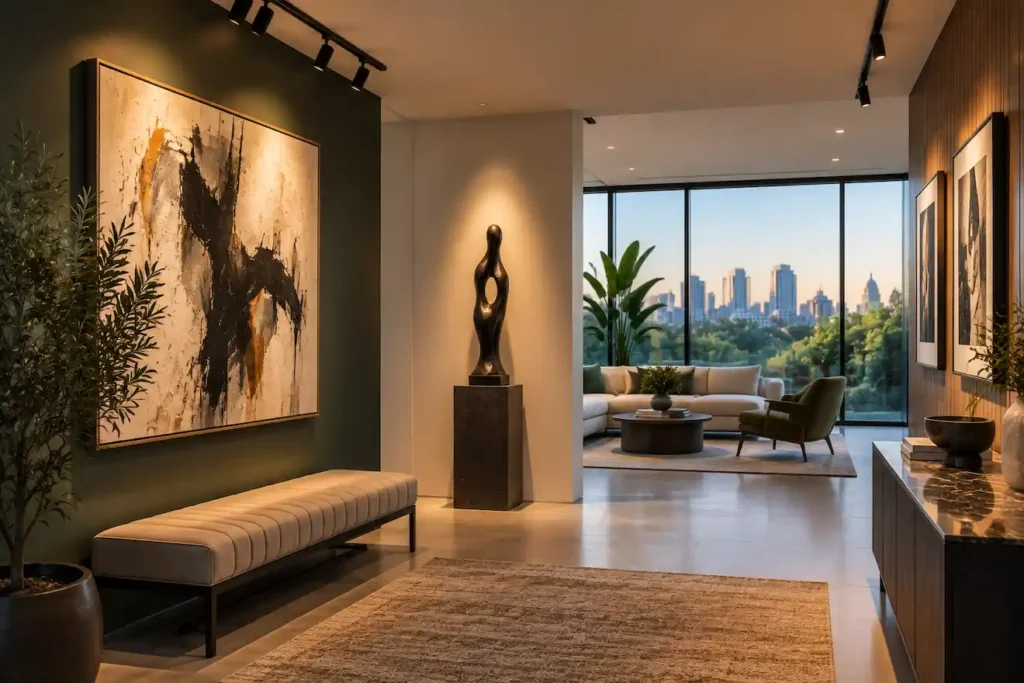
Color Temperature for Smart Gallery Lighting Austin Collections
The color temperature of the light source is where technical specification intersects most directly with the collector’s aesthetic experience. Oils and acrylics, which represent a significant portion of what Austin’s gallery circuit produces, read best under warm light in the range of 2,700K to 3,000K, which enhances the luminosity of earth tones and brings forward the warmth many contemporary painters build into their underpainting.
A piece from a Dimmitt Contemporary Art exhibition or one of East Austin’s Canopy complex studios typically rewards a warm source in a way that a neutral or cool source does not.
Photography and works on paper read more accurately under a cooler source in the range of 3,000K to 3,500K, which preserves the neutral white balance the photographer or printmaker calibrated to. A mixed collection with both warm paintings and cool photographs presents a challenge that a fixed-color source cannot resolve: the temperature that serves the paintings compromises the photographs and vice versa.
Tunable white is the specification-level solution. A fixture that shifts from 2,700K in the evening to 3,500K during the day adapts to both the collection and the changing character of natural light in the room. For Austin homes with significant south or west glazing, smart gallery lighting Austin systems that track those daylight changes maintain a consistent visual relationship between the art and its environment across the full day.
Smart Gallery Lighting Austin: Placement Strategy for Gallery Walls
Smart gallery lighting Austin gallery wall follow different compositional logic than a single featured work, and the lighting strategy needs to reflect that difference. When multiple works of varying sizes are arranged across a single wall surface, the primary challenge is consistent illumination at different heights.
A single ceiling fixture cannot solve this geometry: the angle that works at eye level points too steeply at a work positioned higher and too shallowly at one below. Multiple adjustable accent fixtures, each calibrated to its specific target, allow each piece to be addressed individually.
Fixture spacing follows from the beam angle of the selected source. A narrow-beam fixture at 15 degrees requires closer spacing; a medium-beam fixture at 25 to 30 degrees produces broader coverage with wider spacing, which is often the practical specification in residential settings where the ceiling grid limits placement. Planning the fixture layout before the ceiling is closed is the difference between a gallery wall that can be lit correctly and one where the ceiling configuration forces compromises.
Art at different heights also requires attention to how the eye moves across the arrangement. A single work lit dramatically anchors the composition; uniform gallery lighting creates an experience where works relate to each other as a group rather than competing individually. The right strategy depends on the character of the works, the collector’s intent, and how the wall integrates with the room’s lighting architecture.
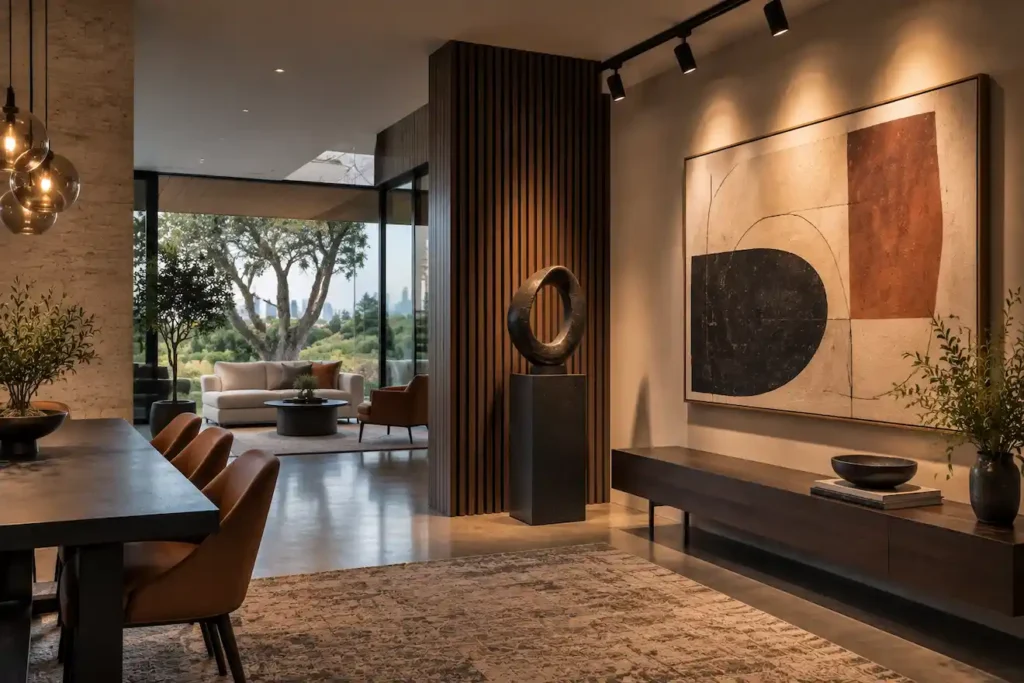
Scene Architecture for Smart Gallery Lighting Austin Homes
Smart gallery lighting in a residential setting is most effective when it is integrated into the room’s scene architecture rather than operated as a separate system. A “Gallery Evening” scene that dims the ambient layer to 15 percent, brings the accent fixtures to 80 percent at 2,700K, and shifts perimeter lighting to a complementary warm tone produces a gallery-quality environment from a single keypad press.
The same room at “Morning” is fully lit at 3,500K for everyday use, with accents present but not dominant, and at “Entertain” the ambient warms to let the art provide visual interest without making the room feel like a museum.
Building these scenes requires understanding how the homeowner actually uses the room at each moment of their day. The result is scenes that feel inevitable rather than programmed because they reflect real behavior. A homeowner who drinks coffee in this room at seven in the morning and hosts dinner at eight in the evening has different lighting requirements at each moment, and the control system that accounts for both produces an environment that serves each well.
Planning Smart Gallery Lighting Austin Into a Renovation or New Construction
The most common limitation in residential gallery lighting is not the available technology; it is the physical infrastructure that was not planned to support it. Accent fixtures require ceiling penetrations at specific locations, dimmer circuits need per-zone allocation, and low-voltage wiring needs to be routed before drywall closes the cavities. In a renovation, each of these is a negotiation between the ideal specification and what the existing structure permits; in new construction, they are a planning exercise that produces the right result if addressed before framing is complete.
Homeowners who engage a smart home integrator at the design phase consistently end up with better smart gallery lighting Austin results than those who retrofit into a completed space. Retrofitting a finished ceiling to add an accent circuit in the correct location typically costs several times more than incorporating that circuit into the original rough-in plan. The timing is what determines whether it is straightforward or disruptive.
For Austin homeowners planning a renovation around a significant art collection, the smart gallery lighting Austin conversation should begin at the same moment as the ceiling height and window placement conversation. A 14-foot ceiling is a dramatic architectural feature and a lighting geometry problem simultaneously, and both need to be designed as one.
If your Austin home holds a collection that deserves this level of attention, connect with Homeva to start with the work and build the lighting specification outward from there.
FAQ
What CRI level does smart gallery lighting Austin require?
A minimum CRI of 95 is the standard for serious residential gallery lighting, matching the museum specification. Pair it with an R9 value above 50, which governs how accurately the source renders saturated reds and warm tones that a standard CRI measurement does not fully capture.
How far should a fixture be from the wall for smart gallery lighting Austin?
At a 9-foot ceiling, position the fixture 24 to 30 inches from the wall at 30 degrees from vertical for even, glare-free illumination across most standard artwork proportions. Ceiling heights above 9 feet require recalculating the fixture offset and the output level for the specific installation geometry.
What beam angle suits smart gallery lighting Austin single-work installations?
A narrow beam of 15 to 25 degrees creates the most focused, dramatic relationship between the lit artwork and the wall, drawing the eye to the piece without significant light spill onto adjacent surfaces. A wider beam of 35 to 40 degrees suits gallery wall arrangements where consistent coverage matters more than individual emphasis.
What color temperature is best for illuminating oil paintings?
Oils and acrylics read best under warm light in the range of 2,700K to 3,000K, which enhances the luminosity of earth tones. Photography and works on paper read more accurately under a slightly cooler source at 3,000K to 3,500K. Tunable white technology allows a single fixture to serve both requirements across different times of day.
Can smart gallery lighting Austin integrate with the rest of the home automation system?
Yes. Lutron’s Ketra and HomeWorks QS make accent fixtures and their color temperature addressable as part of the home’s scene architecture, allowing a gallery mode to trigger simultaneously with ambient adjustments, motorized shade positions, and audio levels from a single keypad or scheduled automation.
Is smart gallery lighting Austin practical for a living room, or only a dedicated art space?
Gallery-quality lighting is most effective when designed into the room’s architecture from the beginning, but it does not require a dedicated art space. A living room with a significant collection benefits from the same beam angle control, CRI specification, and scene architecture as a purpose-built gallery room, with the design approach differing only in how the art lighting integrates with the room’s other functions.